
Best Open Source products of the week May 25, 2026
Explore the most innovative and popular open source products that captured the community's attention during week. These rankings help builders compare standout launches, understand what each product does, and discover practical tools shaping the future of technology.
Period
Weekly ranking
Published for
May 25, 2026
Selection
6 ranked products
Ranked list
Community-backed open source picks
Each product profile includes the launch story, visual preview, and direct product link so readers can move from discovery to evaluation quickly.
01

Crew44 introduces a powerful ecosystem of specialist AI agents, all operating within a secure, local-first workspace on your own machine. Each agent is meticulously designed for a specific role, leveraging the most effective AI model for its task, ensuring optimal performance and results. These agents possess persistent memory and continuously developing skills that compound over time, leading to increasingly sophisticated and efficient problem-solving capabilities. With Crew44, there's no need for an account, it's completely free to use, and fully open source, offering unparalleled transparency, flexibility, and control for users seeking advanced AI assistance.
02

Mobile developers often spend valuable hours building feature branches locally, solely for the purpose of testing a pull request. Tophat dramatically streamlines this process by allowing you to directly pull any Continuous Integration (CI) artifact and effortlessly install it onto simulators or physical devices. This powerful tool is specifically engineered for both iOS and Android engineers, significantly reducing overhead and accelerating the testing phase of your development workflow, letting you focus on coding rather than setup.
03

Pi is a highly adaptable, minimal terminal coding harness built to seamlessly integrate with your existing workflows, rather than forcing you to adapt to it. You can extensively customize Pi with various extensions, specialized skills, personalized prompt templates, and custom themes. These customizations can be bundled as Pi packages and easily shared via npm or git, fostering a collaborative development environment. While Pi ships with powerful defaults, it intentionally skips complex features like sub-agents and plan mode, allowing you to simply ask Pi to build what you need, or install a package that accomplishes it exactly your way.
04

ModelHub is an essential native macOS menu bar application crafted specifically for developers working with local Large Language Models. This intuitive tool simplifies your workflow by enabling you to effortlessly discover models from Hugging Face, download the correct local builds, and efficiently manage your entire model library. It seamlessly integrates with popular platforms like Ollama, MLX, LM Studio, and llama.cpp, allowing you to utilize Hugging Face models with the tools you already rely on, all without the hassle of constantly switching between browser tabs, terminal commands, model cards, and local folders. ModelHub acts as the vital discovery and management layer that enhances these powerful local LLM environments.
05

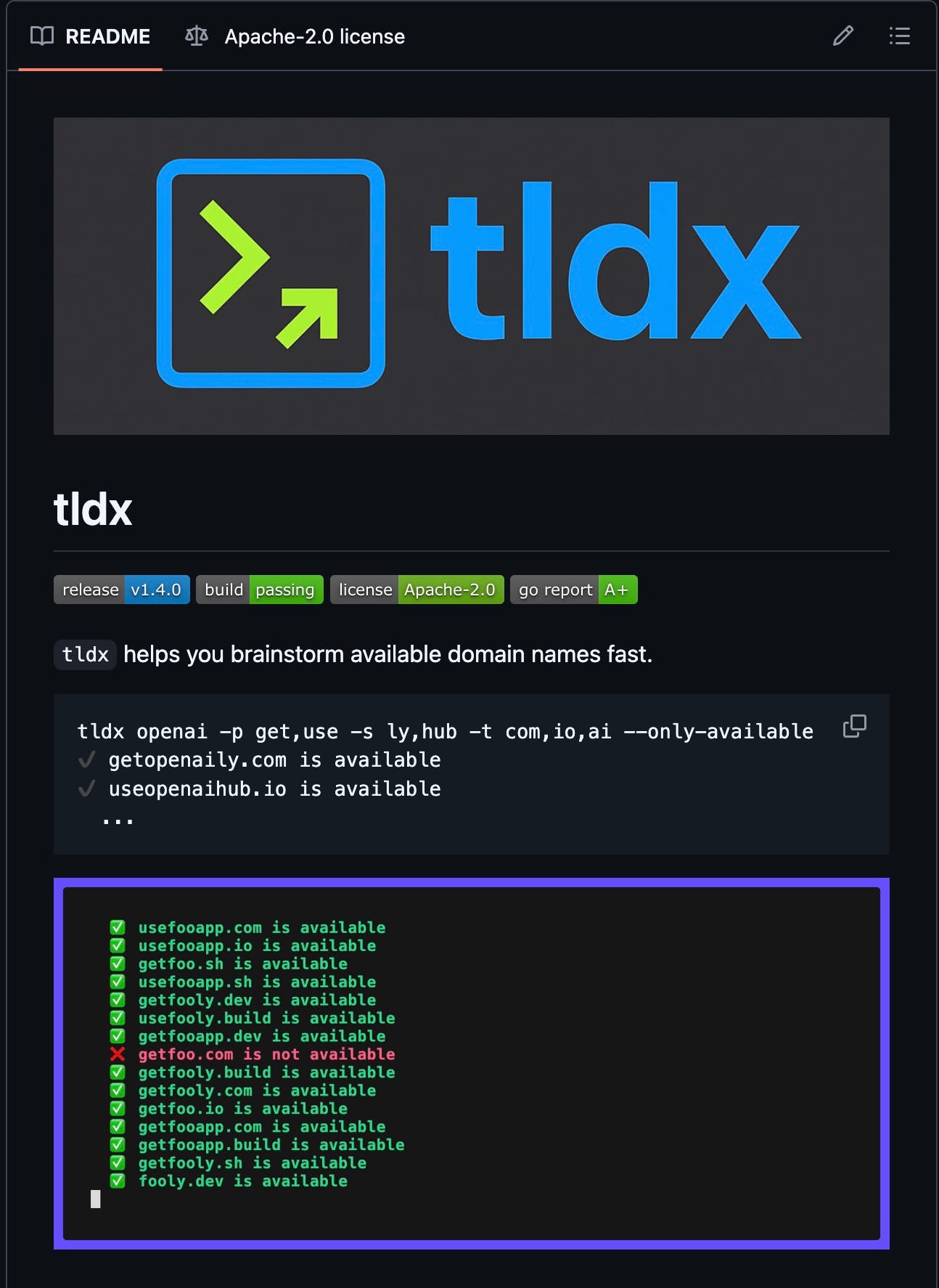
Finding the perfect domain name is often half the battle for any new project. tldx is a blazing-fast, concurrent command-line interface (CLI) tool that efficiently generates and checks domain availability in bulk using the modern RDAP protocol. You can mix keywords, prefixes, suffixes, or even use regular expressions to generate a wide array of options, and then stream the results to stdout, JSON, or CSV for easy analysis. What's more, tldx includes an MCP server, empowering AI agents like Claude to brainstorm and verify domains for you automatically. Install it easily via Homebrew (brew install tldx) and say goodbye to frustrating rate-limits and outdated whois parsing. It is 100 percent Free and Open Source, built robustly in Go.
06

re_gent provides a robust version control system specifically for your AI agent's actions, akin to Git for human developers. It allows you to precisely undo, trace, and maintain granular control over every step your agent takes. With re_gent, you can clearly see exactly what changes your coding agent made, identify the specific prompt that initiated those changes, and effortlessly roll back agent-generated work across multiple files and entire sessions. This ensures transparency and reliability in your AI-driven development.