
Best Open Source products of the year 2026
Explore the most innovative and popular open source products that captured the community's attention during year. These rankings help builders compare standout launches, understand what each product does, and discover practical tools shaping the future of technology.
Period
Yearly ranking
Published for
2026
Selection
10 ranked products
Ranked list
Community-backed open source picks
Each product profile includes the launch story, visual preview, and direct product link so readers can move from discovery to evaluation quickly.
01
Feyn Labs helps you build and deploy specialized AI models tailored to your specific data and workflows. Instead of relying on borrowed models that do not learn from your unique expertise, Feyn allows you to own your weights and create systems that grow sharper over time. Their process focuses on discovering quality metrics, refining your stack, specializing models for your product, and creating feedback loops for continuous improvement in production.
02
Bishakh Ghosh is a researcher and engineer with a PhD from IIT Kharagpur, focusing on blockchain interoperability, distributed systems, and cloud computing. His work spans academic research, software development, and technical leadership, including numerous publications in prestigious computer science conferences. Beyond research, he has hands-on experience in web application development, open-source contributions, and teaching, making him a versatile expert in modern computing architectures.
03

Crew44 introduces a powerful ecosystem of specialist AI agents, all operating within a secure, local-first workspace on your own machine. Each agent is meticulously designed for a specific role, leveraging the most effective AI model for its task, ensuring optimal performance and results. These agents possess persistent memory and continuously developing skills that compound over time, leading to increasingly sophisticated and efficient problem-solving capabilities. With Crew44, there's no need for an account, it's completely free to use, and fully open source, offering unparalleled transparency, flexibility, and control for users seeking advanced AI assistance.
04

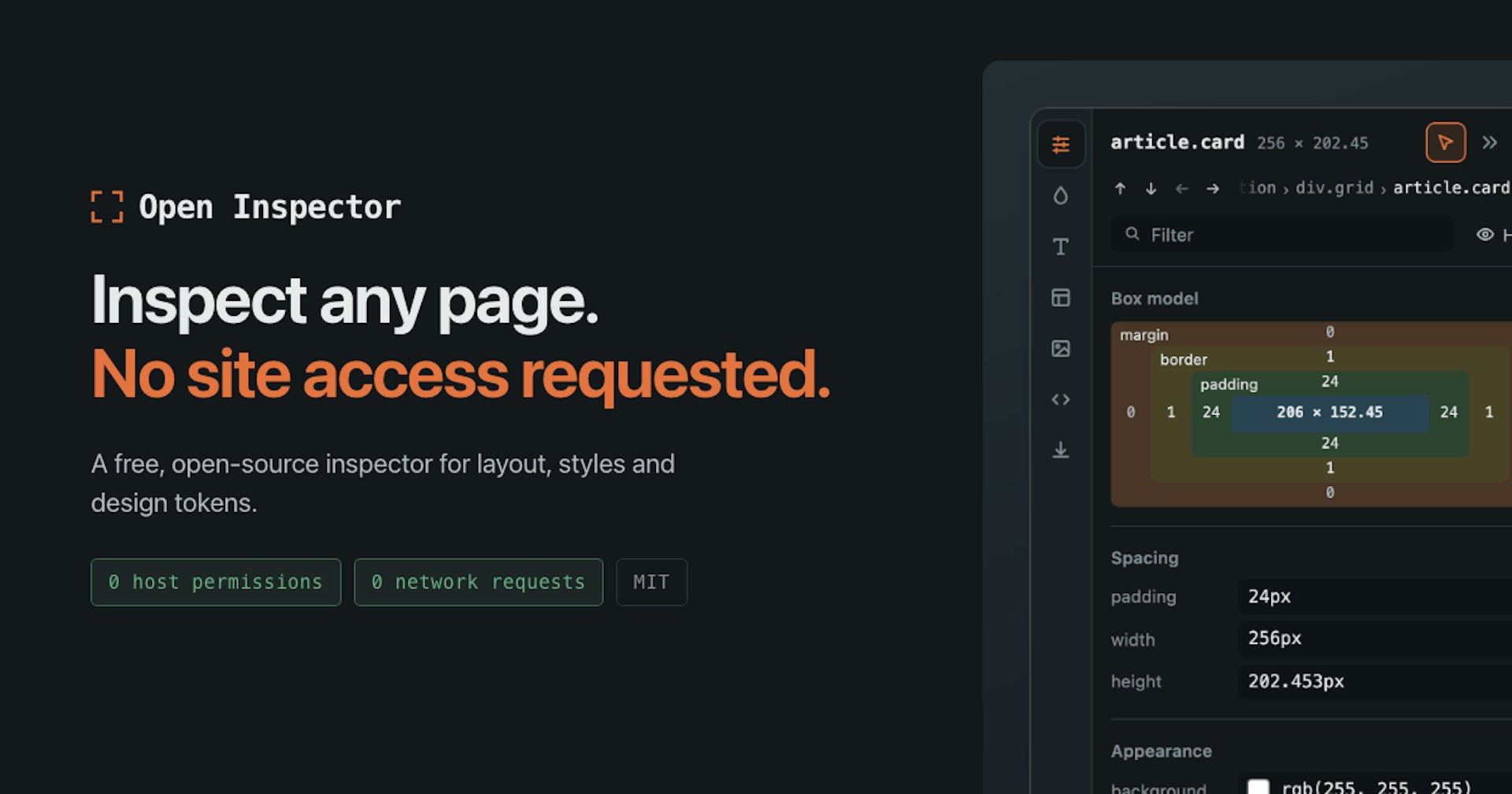
Open Inspector is a free, open-source browser extension that lets you inspect layout, styles, colors, typography, and assets on any page. You can also export its design tokens for use in your own projects. Unlike popular alternatives, it requests no site access and makes zero network requests, so your browsing stays private. It's MIT licensed and requires no account.
05


Beam is a sparse Mixture-of-Experts model with 501 billion total parameters, but only 23 billion active during each step. It is built for coding, reasoning, and agentic workloads, so it can handle long, complex tasks while keeping compute and latency practical. The sparse architecture gives you the broad knowledge of a much larger model without paying the full inference cost on every single request.
06

Lazy is the fastest way to work with AWS resources without leaving your terminal. You can browse everything in your cloud, inspect resources, and run confirmed AWS CLI actions all from one prompt, without hunting through the console or memorizing long commands. It keeps you on your keyboard and gives you confidence by confirming actions before they run. If you live in the terminal and manage AWS, this turns your whole cloud into a command line.
07


withHuman is an approval layer for AI agents. It intercepts your agents' tool calls before they run, then applies rules that approve or deny routine actions automatically. Risky actions are sent to the right person on your team for review. It works with Claude Code, Codex, and agents built with LangGraph, Pydantic AI, and more, all through an open protocol called AAP. One set of rules covers every agent your company runs. The project is open source, and a hosted version is available. Use code PRODUCTHUNT to get 3 months of Scale free, valid until Friday.
08


Navigating between multiple AI coding agents often leads to fragmented workflows and inefficiency. ELVES resolves this chaos by providing a unified, shared workspace, complete with shared memory, offering a single, cohesive environment from which to develop and deploy code. This powerful platform seamlessly integrates with popular tools like Claude Code and Codex, enabling your AI agents to collaborate effectively and ship projects with unprecedented synchronization and ease.
09


Breadcrumb serves as the 'Plausible' for LLM tracing, offering a self-hosted, open-source solution specifically designed for developers. It empowers you to gain deep insights into your AI agents' behavior without the complexity and overhead often associated with enterprise-grade tools like LangFuse or LangSmith. With just three lines of code, your application can be fully traced. An integrated LLM intelligently monitors every trace, automatically flagging critical issues such as incorrect tool calls, looping agents, oversized models, and unexpected cost spikes, often before you even detect a problem. Furthermore, you can effortlessly query your traces in plain English and receive insightful charts and visualizations in response.
10


The Brains turns founders, CEOs and investors into searchable MCP servers built from their public talks, essays, interviews and posts. Ask how Pieter Levels prices, what Paul Graham says about fundraising, or how Ryan Hoover launched Product Hunt, right inside Claude, Cursor, ChatGPT or Codex. Every answer quotes the source with a link. 37 brains today, one URL per brain or one for all. Free, open source (MIT), unofficial and not affiliated with the people.