
INSTACART WEIGHED SELLING ITSELF TO DOORDASH AND UBER. HERE IS WHAT THAT SAYS ABOUT ON-DEMAND DELIVERY. On Friday, October 23, 2026, two reports landed at almost the same time. The Information said Instacart had hired an investment bank to evaluate its options and had held acquisition talks with DoorDash. Bloomberg said Instacart had also approached Uber, and that Uber walked away. Instacart declined to comment on either report. The market reaction was immediate. Instacart shares jumped 9.2 percent to close at $56.44, while Uber fell 3.4 percent and DoorDash dropped 3.5 percent. The asymmetry is the interesting part. Investors treated a possible Instacart sale as good news for Instacart and bad news for the two companies that would have to pay for it. WHAT THE REPORTS ACTUALLY SAY The facts on the table are thin, and it is worth being precise about them. The Information reported that Instacart engaged an advisor and held talks with DoorDash. Bloomberg reported that Uber was also approached and declined to continue. Both outlets characterized the discussions as early and noted they might not produce a deal. That is the entire confirmed surface area. Everything else, including price, structure, and whether DoorDash is still interested, is speculation built on the company's public financials. The New York Post estimated a takeover at roughly $16 billion to $17 billion assuming a 30 to 40 percent premium, but that is an analyst's back-of-envelope figure, not a reported term. There is also a useful historical echo. In August 2021, Reuters reported that DoorDash had held talks to buy Instacart for somewhere between $40 billion and $50 billion, and that those talks fell apart partly over antitrust concerns. Instacart initiated that round too. Five years later, the same two companies are reportedly talking again, at roughly a third of the price. A PROFITABLE COMPANY WITH A GROWTH PROBLEM Instacart is not a distressed asset. It has been consistently profitable on a GAAP basis since 2024, and its revenue has grown every year since it went public. | Year | Revenue | Gross profit | Net income | | | | | | | 2020 | $1.48B | $0.88B | -$0.07B | | 2021 | $1.83B | $1.23B | -$0.07B | | 2022 | $2.55B | $1.83B | $0.43B | | 2023 | $3.04B | $2.28B | -$1.62B | | 2024 | $3.38B | $2.54B | $0.46B | | 2025 | $3.74B | $2.76B | $0.45B | The 2023 loss is an accounting artifact of stock awards tied to the IPO, not an operating problem. The trend that matters is the top line. Revenue grew 33 percent in 2022, 19 percent in 2023, 11 percent in 2024, and about 11 percent in 2025. Q1 2026 came in at $1.02 billion, up 13.6 percent year over year. The business is decelerating from a high base, which is exactly the profile of a company that starts thinking about strategic alternatives. Growth is decelerating because the easy expansion is done. Instacart's marketplace already covers roughly 2,200 retail banners and close to 100,000 stores. There are only so many grocers left to sign. The remaining levers are order frequency, basket size, take rate, and advertising, and those move in single digits, not double digits. WHY THE MATH POINTS TO A SALE NOW The stock is up about 25 percent over the past year and the company carries a market cap above $13 billion. That is a decent hand to play. It is also well below the $39 billion private valuation Instacart held in 2021 and below where it might trade if the grocery delivery market were not getting more crowded. The competitive picture explains the urgency. Piper Sandler downgraded Instacart to Neutral in October 2025 with a $41 price target, arguing the company risks getting "pinched in the middle.
Startup news today
Latest news and SaaS launches and tech products
MICROSOFT'S VOLUNTARY EXIT OFFER: WHAT 60,000 ELIGIBLE EMPLOYEES ACTUALLY MEANS On Monday, Microsoft opened what it calls a Voluntary Exit Offer to employees, a time-limited program that lets eligible staff leave with a severance package instead of waiting for a layoff. Chief People Officer Amy Coleman announced it in a note to employees, and the company published a blog post with the eligibility rules. Reports from Business Insider and Bloomberg, and later the Seattle Times, put the number of eligible employees at around 60,000, roughly a quarter of Microsoft's workforce. Microsoft itself has not confirmed that figure. A spokesperson also told KIRO Newsradio that the company is not positioning the program as a buyout, and the official announcement did not say the intent was to avoid layoffs. Those two details matter, because much of the coverage treats the program as a layoff in a softer wrapper. The reality is more specific. This is a voluntary separation program with a defined eligibility formula, a set of participating organizations, and a decision deadline. Whether it reduces headcount without a formal reduction in force depends on how many people take it. That is a different question from whether Microsoft wants a smaller workforce. It clearly does. WHAT MICROSOFT ACTUALLY ANNOUNCED The program is available to eligible employees at level 70 and below on participating teams in the United States, Canada, the United Kingdom, and India. Not every organization inside Microsoft is taking part. According to Coleman's note, participation varies by business priorities, customer commitments, and workforce needs. Eligible employees receive an email with the details. The offer is time-limited and voluntary, and it builds on the Voluntary Retirement Program Microsoft ran in April 2026. That earlier program was narrower. It covered about 8,750 US employees at level 67 and below whose age plus years of service totaled at least 70, and more than 30 percent of eligible workers accepted. The new program drops the age-and-tenure formula and opens a much broader pool. The company has not published the financial terms. Reporting says the package resembles Microsoft's standard severance, and Neowin reports that employees have until early December to accept, with departures expected by the end of 2026. WHO IS ELIGIBLE, AND WHO IS NOT Microsoft runs on a numeric internal level system, and the cutoff tells you where the program targets. The offer reaches level 70 and below, which reporting describes as the vice president level and below. That is a much wider band than the April retirement program, which stopped at level 67. Geography matters too. The four participating countries cover most of Microsoft's engineering footprint, but eligibility is team-specific. Reporting citing a Reuters source lists key divisions inside the program, including AI experiences, Copilot, finance, human resources, Xbox, and Windows + Devices. The same reporting says marketing, commercial business, and security are excluded. TechCrunch adds data centers, sales, and marketing to the excluded list. The mix is worth noticing. Copilot and AI experiences are in the eligible pool, which flips the assumption that AI teams sit outside workforce actions. Coverage of the April program described AI and Copilot teams as carved out; the October reporting puts them back inside the eligible pool. Xbox and Windows + Devices are the legacy product groups that have absorbed most of Microsoft's cuts over the past two years. Finance and HR are corporate functions. VOLUNTARY EXIT VERSUS LAYOFF The mechanics of a voluntary program are meaningfully different from a reduction in force, for both the company and the employee. In a layoff, the company selects who leaves and gives notice. In a voluntary exit, employees self-select. That changes the candidate profile in the talent market, because people who choose to leave often have runway and negotiate from a stronger position. It also changes the legal and public-relations picture for the employer. Voluntary departures usually do not trigger WARN Act notice requirements in the US, reduce the appearance of a forced reduction, and lower litigation exposure compared with targeted involuntary cuts. The trade-off is that a voluntary program does not guarantee the headcount reduction the company wants, and participation varies by team. The April program's acceptance rate above 30 percent was high for this kind of offer, but it still left most eligible employees in place. A 60,000-person pool with a similar acceptance rate would mean tens of thousands of departures spread over several months, filtered through which teams actually participate. For the employee, the decision is less about the label and more about the package and the alternative. If your org is in the program and your level qualifies, the practical questions are how the severance compares to your unvested equity, how long the healthcare coverage runs, and whether your role would survive a future involuntary round anyway. Those questions have different answers depending on your level and tenure. THE AI CAPITAL BACKDROP Microsoft's workforce actions over the past two years track closely with its capital spending. The company cut roughly 15,000 jobs in 2025 across two rounds, then ran the April 2026 retirement program, then announced this wider exit offer in October. In the same period it committed tens of billions of dollars to AI data centers, and it is one of four hyperscalers expected to spend close to $700 billion combined on AI infrastructure in 2026. That math is visible across the industry. Meta cut about 8,000 roles, roughly 10 percent of its workforce, in the same week Microsoft announced this offer. Amazon, Oracle, and others have run similar reductions while raising AI infrastructure budgets. When payroll and GPUs compete for the same budget line, payroll is the faster lever to move. None of this proves that AI replaced any specific job. Microsoft has not said the offer exists to fund AI infrastructure, and the program covers finance and HR roles that AI does not obviously automate. What the sequence shows is a company rebalancing its cost structure toward compute while shrinking the parts of the org that are most expensive per head and least directly tied to AI product work. WHAT IT MEANS IF YOU WORK THERE If you are inside Microsoft, the analysis is concrete. Confirm whether your organization is participating, since the offer is not company-wide. Check where your level sits relative to the cutoff. Model the package against your unvested stock, because RSU-heavy compensation means a severance offer can look richer or poorer depending on your vesting schedule. And take the decision window seriously: early December is not far away, and the deadline is designed to force a choice. If you are hiring, the cohort that emerges from this program is unusual. It is long-tenured, senior, and self-selected. Many of these engineers and managers built the Azure, Microsoft 365, and Windows stacks over a decade or more, and they are leaving by choice with financial runway. That means they are selective, and they will compare your total compensation against Microsoft's, not just base salary. Companies that want this talent should prepare offers and move quickly, because the strongest candidates will not wait through a slow process. For everyone else, the broader signal is that workforce restructuring at large software companies increasingly happens through voluntary programs rather than announced layoffs. Those programs produce less public data and less obvious job-market signal, which means the visible layoff trackers undercount what is actually happening. THE BOTTOM LINE Microsoft's Voluntary Exit Offer is a real reduction in workforce flexibility, even if the company avoids the word buyout and declines to confirm the 60,000 figure. The eligibility rules are specific, the participating divisions are named in reporting, and the timeline runs through the end of the year. Whether it prevents a formal layoff depends on how many employees sign. The April program suggests a meaningful share will. What the program makes clear is the priority order inside Microsoft right now. Compute and AI product work come first. Legacy product groups, corporate functions, and expensive senior roles come second. Engineers reading the announcement should read it as a structural signal, not just a news event.
WHAT ANDURIL'S BLUECHIP LAPTOP TELLS US ABOUT BUILDING COMPUTERS IN AMERICA On October 27, Anduril and Qualcomm announced BlueChip, a hardened laptop aimed at the military, government agencies, first responders, and law enforcement. Preorders open in 2027. Anduril founder Palmer Luckey framed it as the start of something larger: bringing computer manufacturing back to the United States, not just final assembly but the production of the components themselves, several of which are currently made only in China. The headline number is that roughly 90% of the first generation's bill of materials will come from the US or allied countries, with a stated roadmap to 100% domestic over time. The CPU is the Snapdragon X Series, built at TSMC's Arizona fab. Beyond that, technical details are thin. Anduril has not finished contracting with all of its component suppliers, and no pricing or final specifications have been published. That gap between the ambition and the disclosed detail is where the interesting engineering questions live. THE CPU WAS THE EASY PART The Snapdragon X Series is the one major component with a plausible domestic path today. It is the same silicon Qualcomm already ships in consumer machines like the Microsoft Surface, and TSMC's Fab 21 in Phoenix has been running 4nm-class production since early 2025, with 3nm targeted for 2027. Qualcomm designs in San Diego, TSMC fabricates in Arizona, and advanced packaging for Arizona-produced chips is being stood up nearby through Amkor in Peoria. That is a real achievement, and it is also the least interesting part of the problem. A modern laptop has somewhere north of a thousand discrete components, and the CPU is the one where a US fab already exists because the economics justified building it. Everything else is smaller, cheaper per unit, and harder to move. THE OTHER 10 PERCENT IS THE WHOLE STORY Luckey was specific about what he has and has not solved. He has found an American supplier for the cover glass on the display. He has not found one for the display panel itself, which he named as one of several components still manufactured only in China. He also listed metallics and magnetics among the parts that need domestic sources before the 100% claim means anything. Those categories are easy to underestimate. Display panels are a capital-intensive industry concentrated in a handful of East Asian fabs, and no amount of patriotic intent spins up a Gen 8.5 line quickly. Magnetics, connectors, and passive components are commodity parts made at enormous scale with thin margins, which is precisely why they migrated. A supplier that can make them is not the same as a supplier that can make them at a price and volume a laptop program needs. Anduril's plan is to bring board assembly in-house at its Arsenal-1 facility in Pickaway County, Ohio, the same campus where it started building Fury aircraft in 2026. That addresses a real chunk of the supply chain, but it is worth separating three different claims that get blurred together in announcements like this: where components are manufactured, where they are assembled into a product, and where the money ultimately lands. A board assembled in Ohio from parts made elsewhere is not the same thing as a board built from domestic parts. "AUDITABLE" IS A STRONGER CLAIM THAN "DOMESTIC" Luckey's pitch to government buyers is not really about ruggedness. It is about provenance. He described BlueChip as "the anti-surveillance computer," one where the customer knows every hardware component inside it and every piece of software running on it. That framing matters because it maps onto two different compliance conversations that government buyers already have. The first is trade compliance: the Trade Agreements Act requires that products bought with federal funds be wholly obtained or substantially transformed in the US or a designated country. That is a legal test about where a product becomes a product, not a percentage of its bill of materials. A 90% BOM figure and TAA compliance are related but not interchangeable, and buyers will want the audit trail, not the marketing number. The second is supply chain integrity. A hardware bill of materials that can be traced component by component, paired with a software bill of materials covering firmware and drivers, is what lets an agency answer the question "could something have been substituted in transit?" Most commercial laptops cannot answer that question at all. If Anduril actually delivers a traceable BOM with per-component provenance, that is the differentiator, and the domestic content target is the mechanism rather than the product. The gap between claiming this and proving it is measurable. Component substitution, counterfeit parts, and firmware tampering are exactly the failure modes a traceable supply chain is supposed to catch, and the only way to demonstrate it is to publish the audit method and let customers run it. ARM ON WINDOWS IS THE QUIET COMPATIBILITY RISK Physically rugged hardware is a well-understood engineering discipline. Panasonic's Toughbook line has been the standard in this market for decades, with competitors like Getac and Dell's Latitude Rugged sharing it. MIL-STD-810H certification, IP65 or IP66 sealing, hot-swappable batteries, and sunlight-readable displays are solved problems, and the trade-offs are familiar: weight, battery life, and cost in exchange for surviving drops, dust, water, and vibration. Luckey has already said BlueChip will be heavy and battery-constrained for exactly these reasons. The less familiar risk is the instruction set. Snapdragon X is Arm-based, and Windows on Arm runs x86 applications through emulation. Emulation has improved a great deal, but it is not the hard part for this customer base. Drivers are. A rugged laptop bought by a defense agency is judged by whether it talks to the rest of the kit: smart card readers for CAC authentication, GPS receivers, serial ports for legacy equipment, docking connectors for vehicle mounts, radios, and thermal imagers. Every one of those needs an Arm driver, and many of them are built by vendors who ship Windows x86 drivers only. Qualcomm's PC market share was under 1% as recently as the fourth quarter of 2024, which tells you how much incentive peripheral vendors have had to port. Qualcomm reported a threefold increase in native Windows apps for Snapdragon during 2024, and the trajectory is right, but the long tail of government peripherals is where projects slip. Anduril says it is working on compatibility with Windows applications, government Linux distributions, and older software that agencies still run. That last category is the one to watch. Legacy software tends to be paired with legacy hardware, and a hardened laptop that boots but cannot reach the hardware on the other end of a serial cable is not useful in the field. WHO THIS IS ACTUALLY FOR Luckey was unusually direct about the consumer question. He estimated the price at roughly 20% above a typical high-end PC and said that a normal consumer making a rational decision would be better off with a Dell. He is right, and the admission makes the product strategy clearer: this generation is sold to buyers with a regulatory or security reason to care where the parts came from, not to people comparing benchmark scores. The market he is entering is real but modest. Luckey put rugged computers at about a $5 billion market. That is a small slice of global PC shipments, but it is a slice where customers pay premiums for durability, and where federal procurement channels like the Army's CHS-6 hardware contract provide steady volume. The 100% domestic goal is the part that deserves skepticism, not because the intent is dishonest but because the components in question are made abroad for reasons of scale and capital intensity that a single laptop program does not change. Luckey has acknowledged the internal reputation for ambitious bets. What makes BlueChip different from those is that the intermediate step, a traceable laptop at 90% US and allied content, is a product someone can actually buy and audit. The 100% figure is a roadmap, and roadmaps slip. WHAT TO WATCH BEFORE 2027 The details that will determine whether BlueChip lands are mostly undisclosed. The supplier contracts are incomplete, which means the bill of materials is still moving. The software compatibility story needs specifics beyond "works with Windows and Linux." And pricing at a 20% premium is an estimate, not a commitment, in a hardware market where component costs have been volatile. Three things are worth tracking. First, whether Anduril publishes the traceability model rather than describing it, since the audit is the product. Second, which peripherals and drivers are certified at launch, because that determines whether agencies can deploy it into existing workflows. Third, whether the display and magnetics problem gets a domestic answer on a timeline that survives contact with reality. The CPU being American is a genuine step. It is also the step that was already mostly taken. The rest of the laptop is where the claim gets tested.
On October 27, 2026, Guidewire Software told investors it had signed a definitive agreement to acquire Hyperexponential Ltd for a base purchase price of $1.7 billion in cash, with up to $400 million more in contingent consideration tied to recurring revenue targets. The total package lands near $2 billion. The London-based company, known in the market as hx, builds AI-native underwriting and pricing software for commercial property and casualty insurers. Guidewire, which sells core systems to more than 570 insurers in 44 countries, framed the deal as a bid to define something it calls agentic underwriting: AI agents that assess, price, and recommend decisions alongside underwriters and actuaries rather than in place of them. That framing matters more than the headline number. Commercial underwriting is one of the last corners of financial services where a single experienced person still sits between a stack of documents and a binding price. The work is judgment-heavy, deadline-driven, and stubbornly manual. Guidewire is betting that the layer which governs that judgment, the models, the rating logic, the referral rules, and the audit trail, is worth more than the policy administration system it already sells. Buying it outright is a way of saying the decision layer is where the next decade of margin lives. WHAT GUIDEWIRE IS ACTUALLY BUYING hyperexponential was founded in 2017 and had raised roughly $90 million before this deal, according to PitchBook data cited in coverage of the announcement. Its backers include Andreessen Horowitz and Battery Ventures, and its most recent round, about $73 million, closed three years before the sale. A $1.7 billion base price represents a substantial return for those investors, and a notable exit in an insurtech market that has spent the last few years trimming expectations rather than celebrating them. The company's footprint is the more interesting part. Its software supports underwriting decisions across more than $75 billion in annual commercial P&C premium, and its customer roster includes Aviva, Allianz, Sompo, Beazley, Markel, HDI, Cincinnati Financial, Convex, and Bowhead. TechCrunch reported that nearly 600 insurers across 40 countries use its software. CB Insights lists hyperexponential as a leader in the underwriting appetite intelligence category, ranked against 14 other companies that include Guidewire itself, Applied, and Verisk. Crucially, hx was already inside the Guidewire orbit. It is an existing Guidewire PartnerConnect Technology Alliance Partner, which means a meaningful share of its deployments already sit next to Guidewire policy administration systems. Guidewire is not buying a stranger and hoping for a cultural fit. It is buying a partner whose integration work is partly done and whose product roadmap it has watched from a close distance. What Guidewire is not buying is a data vendor or a distribution channel. hx does not own a unique corpus of loss data in the way a bureau or a reinsurer might. Its asset is engineering applied to the mechanics of pricing: a way to let actuaries build and iterate models and then deploy them into a browser-based workflow that underwriters actually use. INSIDE THE PLATFORM: FROM PRICING ENGINE TO AGENTIC WORKBENCH The origin of hyperexponential's product line is a specialty pricing platform called Renew. Actuaries build models in a custom development environment, largely in Python, and the platform automates deployment of those models so underwriters can use them through a web browser without waiting on an engineering team for every change. That sounds unglamorous, but it addresses a genuine bottleneck. In many carriers, a pricing change takes months because the model lives in a spreadsheet or a specialist tool and the deployment path runs through an overloaded IT queue. From that base, hx has positioned its platform as an agentic layer spanning submission triage, risk assessment, pricing, rating, and portfolio steering. The company describes six defining capabilities for genuinely agentic systems: execution directed by humans inside the carrier's authority model, goal orientation toward underwriting outcomes, data collection across internal and external sources, continuous learning through feedback loops, complex decision-making based on learned patterns, and audit-ready documentation for regulatory purposes. The distinction the company draws is worth taking seriously. Rules engines follow predetermined scripts. Generative AI typically needs a human to direct it at each step. Agentic systems are meant to orchestrate a workflow end to end, adapting to new scenarios, while escalating the calls that require human judgment back to the underwriter. In practice, that means a pipeline that receives a broker submission, classifies documents, extracts fields from ACORD forms, loss runs, and financial statements, normalizes the data against a standard schema, enriches it from external sources, and delivers structured output to the rating engine, routing exceptions to a person. Some of the operational claims attached to this kind of architecture are striking. The company's own write-up cites extraction accuracy of 92 to 94 percent for insurance-specific entities when natural language processing is combined with computer vision. It points to Hiscox achieving a 99.4 percent reduction in cycle time for London Market specialty lines, cutting quote turnaround from three days to three minutes while leaving final pricing authority with the underwriter. It also references AmTrust extracting risk data from competitor proposals to generate bindable quotes, and N2G Worldwide increasing underwriter quote capacity by 40 percent while cutting cycle times by 60 percent. Those numbers come from vendor and analyst material and should be read with the usual caution. A 99 percent cycle-time reduction is a description of a specific, narrow workflow, not a claim that underwriting now takes three minutes from start to finish. Still, the direction is consistent with what carriers report elsewhere: the constrained resource is not appetite but capacity to process submissions. THE PRICE, THE STRUCTURE, AND THE GROWTH MATH The financial mechanics reveal as much about Guidewire's intentions as the press release language does. The base price is $1.7 billion in cash, subject to adjustments. The extra $400 million is contingent on hitting specified recurring revenue targets, which means a meaningful slice of the payout depends on how well hx's subscription business performs after closing, not just on how well the integration goes. Guidewire expects to fund the deal with $1.0 billion in new term loan financing plus existing cash on hand. It has a binding debt commitment for the loan from Bank of America and Citibank. Centerview Partners advised Guidewire on the financial side, with Latham & Watkins as legal counsel. J.P. Morgan advised hyperexponential, with Wilson Sonsini Goodrich & Rosati (UK) as legal counsel. Closing is expected in the second quarter of Guidewire's fiscal 2027, a period that does not align with the calendar quarter of the same name. The guidance implications are specific. Guidewire says the acquisition should contribute at least 650 basis points to fiscal 2027 ARR growth on an inorganic basis. Starting in fiscal 2028, it expects at least 150 basis points of contribution to durable organic ARR growth. That second figure is the more telling one. Describing a contribution as organic a year after closing implies Guidewire intends to stop treating hx as a separate unit and start selling it through its existing distribution and account relationships. Guidewire also said the deal will have no impact on the first quarter fiscal 2027 guidance it issued in September 2026, with updated full-year guidance coming on its December 2026 earnings call. For a sense of scale, 650 basis points of ARR growth is 6.5 percent of Guidewire's recurring revenue base in a single year, all of it added by acquisition. That is a large inorganic contribution for a company whose core business grows by selling long, complex implementations to a finite population of large insurers. It also explains the willingness to take on $1 billion of debt: the asset being purchased is recurring, high-margin software revenue that plugs directly into the metric public markets reward most. WHY AGENTIC UNDERWRITING, AND WHY NOW The strategic logic rests on a set of market observations that have been circulating in insurance technology for several years and are now showing up in buying behavior. hyperexponential's own analysis, drawing on Accenture and McKinsey material, puts adoption of agentic AI in underwriting at 14 percent today with a forecast of 70 percent by 2028. It cites loss ratio improvements of 3 to 5 percentage points for European and North American P&C insurers using advanced analytics, along with new business premium gains of 10 to 15 percent and broker retention improvements of 5 to 10 percent. For a $1 billion premium commercial portfolio, a four-point loss ratio improvement is roughly $40 million in annual underwriting profit. Independent research supports the direction while tempering the pace. An Economist Impact report sponsored by SAS found insurance leaders expecting a hybrid workforce of humans and AI agents, with agentic systems working largely independently under human oversight, but also found that gains so far have been more incremental than transformational. A Capgemini Research Institute study is blunter about the human side: while 62 percent of executives say AI and machine learning are elevating underwriting quality and reducing fraud, only 43 percent of underwriters trust and regularly accept automated recommendations. The stated reasons for hesitation are perceived overcomplexity, cited by 67 percent, and concerns about data integrity, cited by 59 percent. That gap between executive enthusiasm and underwriter trust is the central commercial risk in this category, and it is the thing the acquisition is designed to address. Guidewire's argument is that insurers already trust it with the policy and risk data that underwriting depends on, and that putting the decision layer inside that trusted perimeter is easier to sell than asking a carrier to bolt on a standalone AI vendor. The structural backdrop reinforces the point. Capgemini's research identifies insufficient access to data, cited by 54 percent of executives, legacy systems, cited by 51 percent, and a lack of skilled talent, cited by 47 percent, as the barriers holding underwriting back. hyperexponential's platform is explicitly designed as an intelligence layer that connects to existing systems rather than replacing them, integrating with email servers, data lakes, policy systems, and external APIs. That architectural stance is precisely what makes it acquirable by a core system vendor rather than threatening to it. THE HARD PART: TRUST, INTEGRATION, AND CHANNEL CONFLICT The risks are not hard to identify. The first is integration in the technical sense. Agentic workflows depend on clean data flowing between systems in near real time. Carriers running older policy administration platforms, or heavily customized ones, will not get the full benefit without remediation work that Guidewire's professional services organization will end up doing. Guidewire's implementation record, more than 1,700 projects, is an asset here, but it also means the acquisition adds a new class of work to a services motion already operating at scale. The second risk is channel conflict. hyperexponential's customers include insurers that do not run Guidewire core systems. Some of them chose hx precisely because it was independent of their policy administration vendor. Once hx belongs to Guidewire, competitors in the core system market have an obvious reason to steer their customers elsewhere, and carriers have an obvious reason to worry about pricing leverage. Guidewire will need to reassure non-Guidewire customers that the platform will continue to integrate with rival systems, and it will need to do so with contractual commitments rather than press statements. The third risk is people. The earnout structure helps retain founders and key staff through the revenue targets, but earnouts also create tension: they can reward short-term revenue pursuit over the slower work of integration. Amrit Santhirasenan, hx's CEO and co-founder, framed the company's founding conviction as a belief that underwriting judgment is the highest-leverage work insurers do. Retaining that conviction inside a larger, publicly traded organization with quarterly targets is a management problem, not a technology one. The fourth risk is regulatory and explainability pressure. Agentic systems that recommend prices and flag referrals need to be defensible to regulators, and audit-ready documentation is one of the capabilities hx explicitly markets. As these systems move from assisting underwriters to acting on their behalf within delegated authority, the evidentiary burden grows. Carriers in multiple jurisdictions face inconsistent requirements, and a platform that cannot produce a clear record of why a decision was made will not survive procurement review. WHAT IT MEANS FOR INSURERS AND THE WIDER MARKET For carriers evaluating agentic underwriting, the acquisition changes the buy-versus-build calculus. Buying from a startup carried vendor risk; buying from a core system vendor carries concentration risk. The practical response is to insist on portability. Carriers should ask how models are versioned, whether rating logic can be exported, how the platform behaves if the relationship ends, and what the integration surface looks like for systems outside the Guidewire stack. They should also separate the two questions that vendors like to merge: does the tool improve quote throughput, and does it improve loss ratio. The first is easy to measure and easy to demo. The second takes underwriting cycles to prove. For the wider market, the deal is a consolidation signal. Core system vendors have spent a decade building marketplaces of partner applications rather than buying the categories outright. Guidewire has now reversed that pattern in the most consequential category, the pricing and decision layer. That puts pressure on other platform providers to decide whether they build, partner, or acquire similar capability, and it puts pressure on independent underwriting software vendors to prove they offer something a core system cannot simply absorb. The CB Insights category ranking, which places Guidewire alongside Applied and Verisk in underwriting appetite intelligence, suggests the competitive set is already overlapping. There is also a simpler read. Insurance software has long been sold as infrastructure: systems of record that store policies and process transactions. The interesting margin has moved to systems of judgment, where the software shapes what a human decides and how consistently they decide it. Guidewire is paying roughly $1.7 billion, plus performance payments, for a position in that layer while the adoption curve is still early. Whether that looks expensive or cheap in five years depends less on the technology than on whether underwriters end up trusting it. The tooling will be ready long before the culture is, and the acquisition's success will be measured in loss ratios and quote-to-bind times rather than in agent counts. REFERENCES * Guidewire Signs Definitive Agreement to Acquire hyperexponential * Guidewire buys Hyperexponential for $1.7B in cash * Agentic AI in insurance underwriting: 6 use cases
In late October 2026, Bank of America sent customers an email with a title that reads like it was written through gritted teeth: "Protecting your finances in the AI World." The message inside was blunt. Never share your username and password with another person or an outside service, the bank said, "including an AI-enabled tool or agent that offers to act on your behalf." A spokesperson later confirmed the email was genuine after a copy circulated on social media. The warning is easy to skim past as generic security hygiene. It is not. It marks a real collision between two things happening at once: consumers are adopting personal AI agents fast enough that handing over logins feels like a convenience feature, and banks are pouring billions into their own AI programs while still trying to work out how third-party agents should ever be allowed near a customer's money. Bank of America's email sits precisely on that fault line, and its most uncomfortable sentence is the one about consequences: "If you do share your credentials, keep in mind that you're responsible for activity resulting from that access." WHAT THE BANK ACTUALLY SAID, AND WHY IT SAID IT The email's core instruction is unremarkable on its face. Banks have spent two decades telling people not to reuse passwords, not to respond to phishing, and not to give anyone their login. What is new is the category of recipient. An AI agent is not a stranger on the phone and it is not a data aggregator quietly scraping a statement. It is a tool the customer deliberately installed, often paid for, and increasingly trusts with the kind of task that used to require opening an app and tapping through a few screens. The risks the bank is pointing at fall into three buckets, and each one fails differently. The first is unauthorized action. An agent holding valid credentials can move money, change contact details, open a product, or initiate a transfer without a human confirming each step. The customer granted access once and may not see the result until a statement arrives. An agent that misreads an instruction, acts on a stale goal, or is manipulated by a prompt injection in a web page or email it processes can produce an outcome nobody intended. The second is defensive overreaction by the bank itself. Fraud systems are built to notice logins and transactions that do not look like the customer's normal behavior. An agent that checks balances at 3 a.m. from an unfamiliar network, or fires off several transactions in a pattern no human would produce, can trip those systems. The result is not a friendly notification. It can be a lockout, a frozen card, or a lengthy identity verification process at exactly the moment the customer needs access. The third, and the one with the longest tail, is credential leakage. An AI assistant is a piece of software with its own supply chain: model providers, plugin integrations, browser extensions, logging pipelines, and support staff. A flaw anywhere in that chain can expose stored passwords. Unlike a stolen password that a customer might eventually notice and reset, a credential sitting quietly in an agent's storage may be copied and reused without any visible signal for months. THE AWKWARD PART: THIS BANK IS AN AI PIONEER The warning lands with extra weight because Bank of America is not an AI skeptic. It is one of the more deliberate AI operators in financial services, and its public posture has been that AI belongs in the foundations of the company rather than in isolated experiments. Its consumer assistant, Erica, launched in 2018 and has since logged billions of client interactions. The bank has described an internal strategy of building once and reusing the underlying architecture across business lines, which is why the same natural language engine that supports retail customers also shows up in wealth management and corporate banking tools. That reach extends to employees as well. The bank has reported that more than 90 percent of its roughly 213,000 employees use an internal virtual assistant, and in July 2026 it announced generative AI enhancements to EricaAssist, a human-assisted agent used by more than 18,000 customer service representatives. The company says the tool surfaces contextual guidance in under three seconds and trims nearly a minute from the average call. Its chief technology and information officer has described a pivot away from small proofs of concept toward end-to-end process transformation, backed by a technology budget in the tens of billions with a substantial share reserved for new initiatives. So the bank is not telling customers that AI is dangerous. It is telling them that AI is fine when the bank runs it, inside governance the bank controls, and something else entirely when a stranger's agent holds the keys. That distinction is the heart of the story, and it is worth taking seriously rather than dismissing as institutional hypocrisy. A bank-operated assistant like Erica works within a permissioned environment. It reads from systems the bank already governs, answers questions, and performs a limited set of actions under rules the bank defines and can audit. An external agent arrives with no such contract. It holds a password that unlocks everything, because that is what a password is: an all-or-nothing key that cannot be narrowed to "read my balance" or "pay this one bill." WHY BANKS CANNOT SIMPLY WAVE AGENTS THROUGH The industry's hesitation is not just cultural caution. It is a governance problem with a genuinely difficult shape. In an April 2026 interview, Bank of America's technology chief framed the tension plainly: governing this technology is hard, because overdoing it stalls innovation while underdoing it introduces a lot of risk. That is not a dodge. It is an accurate description of the trade-off every large institution is now managing. The scale of the problem makes it sharper. The bank supports thousands of internal processes and is treating AI as something to be scaled across all of them. Enterprises broadly expect to increase generative AI spending substantially in 2026, which pushes the technology deeper into workflows and raises the stakes on guardrails. Meanwhile, the industry is still working out what an authorized agent even looks like at the account level. Reports in October 2026 described major U.S. banks detecting what they believed were unauthorized actions by third-party AI agents operating inside customer accounts, with some agents apparently acting beyond what users had instructed. That is the scenario bank risk teams have been dreading: access that was granted, actions that were not. Distinguishing between the two after the fact is genuinely hard, because the login looks legitimate and the device may be the customer's own. WHO PAYS WHEN THE AGENT GETS IT WRONG The email's liability sentence is the part customers should read twice. Account agreements at most banks hold customers responsible for activity conducted by anyone they give their login to. An AI agent is, in the eyes of that agreement, someone you gave your login to. The bank has not authorized the agent, has no relationship with it, and cannot audit what it does. If it drains an account through a misread instruction, the starting position is that the customer authorized the access. That asymmetry is what makes the credential-sharing question more than a security tip. It is a risk transfer. The convenience accrues to the customer in the short term, in the form of an assistant that can check balances or move money on request. The liability stays with the customer indefinitely, and the bank retains the right to treat the resulting activity as the customer's own. This is also why the bank's warning is phrased as a request rather than a technical control. Banks cannot easily block a login that arrives with the correct password and a plausible device fingerprint. They can only detect anomalies afterward and act on them. That leaves prevention almost entirely in the customer's hands, which is an uncomfortable place for an industry that markets itself on protecting deposits. WHAT A SAFER DELEGATION MODEL LOOKS LIKE The alternative to password sharing is not "no AI agents." It is delegated access: a permissioning layer where a customer grants a specific, limited, revocable authorization to a third party without ever disclosing the underlying credential. The pattern is well established in other corners of the internet. An authorization flow issues a token scoped to particular actions and a particular duration, the customer can revoke it without changing their password, and the bank can see exactly which application is acting and what it was permitted to do. Open banking arrangements already provide a version of this for data sharing. In a statement to CBS News in October 2026, JPMorgan Chase said customers should not give their username and password to anyone and pointed to secure, customer-authorized data sharing through open banking providers as the way to meet customer needs while keeping accounts safe. That is the model the industry would prefer to extend to agents: the bank stays in the loop, the permission is narrow, and the audit trail is real. The hard part is that agentic payments ask for more than read access. An agent that buys something at the best price or at the right moment needs the authority to initiate a transaction, which means the permission model has to carry spending limits, merchant categories, time windows, and a clear answer to what happens when the agent gets it wrong. Those are solvable design problems, but they are not solved yet, and they require banks, payment networks, processors, and agent developers to agree on interfaces that do not currently exist in any standardized form. There is also a governance question inside the agent itself. Banks build their assistants with human oversight, transparency, and accountability baked into the design, and Bank of America says its responsible AI strategy requires human oversight for all outcomes. A consumer-grade agent bought off the shelf carries no such guarantee. Its operator may have no idea it is being used for banking at all, and its security posture was never designed for credentials that guard a person's savings. A PRACTICAL STANCE FOR CUSTOMERS RIGHT NOW The realistic advice sits between two extremes. Handing a general-purpose AI assistant your banking password is a bad trade today, not because AI is uniquely dangerous but because the permission model is wrong. You are giving an all-or-nothing key to software you do not control, operated by a company with no contractual relationship to your bank, and you are absorbing the liability for whatever it does. If an assistant genuinely needs to see account information, the safer path is the one the industry is already building: bank-sanctioned connections that issue scoped permissions rather than passwords. Where those do not exist yet, the next best option is to keep credentials out of the agent entirely and use the bank's own tools, which is exactly what the bank's email is asking for, however politely. There are a few habits worth adopting regardless of how the market develops. Never paste a banking password into a chat window, even if the assistant claims it will not store it. Treat any agent that asks for a password as a warning sign rather than a feature. Turn on multi-factor authentication so that a leaked password alone is not enough. Review account activity on a regular cadence rather than waiting for a statement. And if you do decide to delegate access anyway, understand that you have taken on the risk, not the bank. THE ROAD TO AGENTIC PAYMENTS RUNS THROUGH GOVERNANCE The awkward reality is that the convenience customers want is coming. Agentic payments, in which a person sets an agent to buy at the best price or the right time, are being actively explored by banks, payment providers, and processors. The demand is real and the technology works well enough to be tempting. What is missing is the connective tissue: standards for delegated authority, dispute rules for transactions an agent initiated, and clarity about which party absorbs the loss when an autonomous system does something nobody asked for. Until that exists, warnings like Bank of America's will keep arriving in inboxes. They are not a rejection of AI. They are a statement about where the boundary currently sits: the bank will build agents it can govern, and it will not extend that governance to agents it cannot see. Customers who bridge that gap with a password are, in effect, doing the integration work themselves and keeping all the downside. The email's tone may read as frustration, but the underlying position is coherent. A password is a master key, and master keys do not come with spending limits or an audit log. Until agents can be granted narrow, revocable permission to act, the safest answer to "can I have your banking password" remains the one the bank gave: no, and please do not ask again. REFERENCES * Bank of America kindly asks that you don't share your banking password with your AI assistant * Bank of America tech chief shares AI strategy focus * Bank of America Enhances EricaAssist with Generative AI to Help Employees Resolve Client Needs Faster
The AI buildout has spent the past two years being described mostly as a problem for the electric grid: too much load, arriving too fast, landing in places the wires were never sized to serve. That framing is accurate as far as it goes. But at TechCrunch Disrupt, three people who work directly on the problem argued that the pressure is also doing something the industry has struggled to do on its own, which is create a reason to modernize. Apoorv Bhargava, founder and CEO of WeaveGrid, Tim Heidel, CEO of Veir, and Kristin Eberhard, VP of policy at Rewiring America, all acknowledged the strain. They also pointed out that the scale of investment in AI infrastructure is pulling technologies off the shelf and into deployment at a pace that ordinary utility planning cycles rarely allow. That is the upside worth taking seriously: not that data centers are harmless, but that scarcity has become a forcing function. The concern is not invented. Data center connections have become a real source of tension for grid operators, with warnings about higher bills in the near term and reliability risk further out. What the Disrupt panel added was a second half to that sentence. "The scale of the investment in AI infrastructure is driving a tremendous amount of innovation," Heidel said. "There's a ton of new technologies that are coming off the shelves and starting to get to scale that, pulled together, can actually really make sure that data centers are the best community neighbors and citizens they can possibly be." WHY AI LOAD STRESSES THE GRID DIFFERENTLY THAN ORDINARY DEMAND GROWTH Electricity demand in the United States was roughly flat for years, which let utilities plan around slow, predictable growth. Data centers change the shape of the problem in three ways. First, the requests are large and arrive in clusters. A single campus can ask for hundreds of megawatts, and multiple campuses often converge on the same corridor because they are chasing fiber routes, land, tax incentives and each other. Second, the load is spiky. Training workloads and inference traffic do not draw power in a smooth band; they swing. Third, and most importantly for the engineering, the binding constraint is frequently local. A region can have plenty of generation and still have a transformer, feeder or substation that cannot take another megawatt without an upgrade. That last point is what makes the current wave different from previous load growth. Traditional planning tools and demand management programs were not built for bottom-up, asset-driven risk. Utilities often have no clear visibility into localized stress until assets are already overloaded. "It's a very different electric grid, right?" Bhargava said. "We're dealing with a ton of new variables, including renewable energy. We're dealing with a ton of new load in the form of electric vehicles and data centers and heat pumps, and the ability to manage and orchestrate is fundamentally what utilities are now grappling with." THE BOTTLENECK IS OFTEN NOT GENERATION The mismatch that creates room for innovation is one of timelines. Grid infrastructure moves slowly. Transmission projects take years to site, permit and build, and distribution upgrades are gated by equipment lead times, crews and capital budgets. AI infrastructure moves on a different clock. When a hyperscaler wants a campus energized in a fraction of the time a new line takes, the practical answer stops being "build more" and starts being "use what is already there more intelligently." That is the fork in the road the industry is now standing at. One path is to expand and densify the physical grid. The other is to orchestrate demand so existing assets are not overwhelmed. The interesting thing about the current moment is that both paths are being funded at once, by different companies with different technical bets. TWO PATHS, TWO KINDS OF INNOVATION WeaveGrid and Veir sit on opposite sides of that fork. One sells software that changes when and where power is drawn. The other sells hardware that changes how much power a given piece of real estate can carry. | Dimension | Load orchestration (WeaveGrid) | Power delivery hardware (Veir) | | | | | | Primary lever | Timing and location of flexible demand | Physics of the conductor | | Unit of action | Device-level signals to EVs, batteries, thermostats | Superconducting cable and cryogenic cooling systems | | What it avoids | New distribution capacity for peak hours | Copper-intensive, space-hungry power runs | | Time to value | Software deployment on existing assets | Manufacturing scale-up and commercial projects | | Main limits | Enrollment, consent, measurement, interoperability | Cryogenic complexity, cost, early-stage supply chain | Neither approach solves the capacity problem alone. But together they illustrate why the "data centers versus the grid" framing is too simple. The load is the reason both markets exist. SOFTWARE: SEEING AND SHAPING LOAD AT THE ASSET LEVEL WeaveGrid started in EV managed charging, which turned out to be a useful training ground. Electric vehicles are large, mobile, schedulable loads attached to cloud-connected devices, and orchestrating them at scale teaches you how flexibility actually behaves on a distribution system. In January 2026 the company extended that model beyond EVs with an expansion of DISCO, short for Distribution Integrated System Capacity Orchestration, to cover a broader set of flexible loads and distributed energy resources. The mechanics matter. DISCO pulls in vehicle telematics and data from cloud-connected devices, then sends individualized charging and dispatch signals so that load shifts away from moments when a transformer, feeder or bulk system constraint would otherwise be breached. The utility gets continuous, hyper-local visibility into how much flexible capacity is available, and a single interface to forecast, manage and verify load shaping across hundreds of megawatts. "DISCO creates a new orchestration layer for utilities, a single pane of glass to see and manage all flexible assets, unlocking more capacity from the grid infrastructure they already have," Bhargava said when the expansion was announced. The commercial pitch is straightforward: serve more load on existing infrastructure, protect reliability, and defer or avoid costly distribution upgrades, which in turn helps keep bills down. That affordability argument is the one that resonates with regulators, because the alternative is a rate case for capacity that may only be needed a few hours a year. The approach depends heavily on partnerships. WeaveGrid runs managed charging and time-of-use programs with utilities including Pacific Gas and Electric, Dominion Energy, DTE, Xcel Energy, Baltimore Gas and Electric, Alabama Power, Ameren Illinois and Portland General Electric, and integrates directly with automakers and device makers such as Toyota, Lexus, Rivian, Hyundai, Kia, ChargePoint, Wallbox, Emporia, SolarEdge, FranklinWH and ecobee. Enrollment friction is the quiet killer of demand flexibility programs, and direct integrations are how that friction gets removed. The company also carries a standards and security story that utilities need before they will let software touch customer devices. It holds SunSpec CSIP certification for an IEEE 2030.5 Aggregator Client, and SOC 2 Type II across all five trust service criteria. Program expansions have moved through regulators, including a Maryland Public Service Commission decision extending BGE's Smart Charge Management offering. The limits are worth stating plainly. DISCO is strongest as behind-the-meter load shaping; it is not a replacement for a distribution management system, a power-flow study suite or a network model of record. Its public developer surface is thin, with a partner API for aggregators but no public specification. Some drivers report friction with charger control and question savings that can overlap with self-managed time-of-use scheduling. And security evidence tends to be shared privately rather than published. HARDWARE: SUPERCONDUCTORS AND THE LIMITS OF COPPER Veir takes the other path. The Woburn, Massachusetts company, founded in 2019 and led by Tim Heidel, builds high-temperature superconducting power delivery systems. The architecture combines superconducting cables with a cryogenic cooling system, controls, termination units and monitoring. Superconductors carry large amounts of current with very low resistance when cooled to low temperatures, which means more power through a smaller footprint than copper-based systems allow. The company has said its cables can carry power five times farther than traditional cables while requiring 20 times less space. In October 2026 it closed an oversubscribed $110 million Series C co-led by Matter Venture Partners and Tyche Partners, with participation from LG Technology Ventures, Gates Frontier, Sabanci Climate Ventures and Hui Capital, plus existing investors including Engine Ventures, Galvanize Climate Solutions, Piva Capital, Congruent Ventures and VXI Capital. Total capital raised reached $225 million. The milestone behind that round was a demonstrated 3-megawatt superconducting power delivery system. Veir is now working with customers and industry partners on reference designs for AI campuses and preparing for initial commercial deployments, while building out manufacturing and supply chain capacity. "AI infrastructure is advancing at a pace that requires us to rethink how power is delivered, not simply optimize the systems that exist today," Heidel said. "This financing gives us the resources to move from demonstrating the potential of superconducting power delivery to manufacturing and deploying systems at commercial scale." The strategic detail is where Veir is starting. Its initial commercial focus is behind the meter at AI data centers, meaning power distribution inside a customer's own facility rather than across the wider utility grid. That is a deliberate sequencing choice. Behind-the-meter projects involve one sophisticated customer, a defined engineering scope and fewer of the siting and permitting hurdles that transmission projects face. It is also where the pain is most acute: as campuses get denser, the physical space and labor required to run copper becomes a real constraint on how fast compute can be energized. "Power delivery to AI server racks is emerging as one of the critical constraints on how efficiently and densely AI compute can scale and cluster," said Wen Hsieh of Matter Venture Partners. Tyche Partners made the same point more bluntly, describing the physics of copper as a fundamental limitation. The open questions are real. Cryogenic systems add operational complexity and maintenance requirements that conventional cable does not. Cost per meter at commercial scale is not yet publicly established. The company is still building the manufacturing and installation ecosystem needed for repeatable deployments. And because the first market is behind the meter, the near-term benefit to the wider grid is indirect, arriving through faster campus energization rather than through added transmission capacity for everyone else. THE IMPROV ERA Eberhard of Rewiring America framed the current period in a way that cuts through the usual either-or debate. Her organization advocates for household electrification, which means she spends her time on another source of new load: heat pumps, induction stoves and home EV charging. "I feel like this era of AI and load growth is a very improv era," she said. "There's a lot of yes-and-ing going on. So yes, we need more transmission lines. Yes, we need more centralized power plants, and we also need to make sure that we're taking advantage of all this other stuff that we had previously been leaving on the table when we didn't have this urgency of the AI demand." That is the most useful idea in the whole discussion. The urgency created by AI demand is not replacing the traditional grid agenda; it is adding to it. Transmission, generation, distributed flexibility, managed charging and higher-capacity conductors are complements, not substitutes. What changes under pressure is the willingness to run them in parallel and to accept less familiar technologies in the portfolio. It also changes the politics. Flexibility programs that once struggled to get budget attention suddenly have a constituency. A utility that can defer a substation upgrade by shaping EV and battery charging has a story for its regulator. A data center operator that can energize racks faster with a smaller power footprint has a story for its board. WHAT HAS TO GO RIGHT Optimism about grid innovation is only credible if the hard parts get solved. Several stand out. Measurement and verification. Flexibility is only a capacity resource if its contribution can be measured and paid for. Utilities need defensible baselines, auditable reporting and settlement-grade data. WeaveGrid emphasizes reporting and verification as part of DISCO's value, and that is not a marketing detail; it is the difference between a pilot and a program. Consumer consent and control. Orchestration only works at scale if customers trust it. Override capability, clear communication and predictable savings matter more than elegant optimization. Driver complaints about control friction and questioned savings claims are a warning about what happens when the software gets ahead of the user experience. Interoperability. Utilities buy standards, not just products. IEEE 2030.5 and CSIP certification provide a common language for aggregator-to-utility links. Gaps remain, notably around other protocol coverage and wholesale market interfaces, and those gaps determine how far a single vendor's platform can reach. Regulatory throughput. Programs have to be approved, and approvals take time. The Maryland decision extending BGE's managed charging offering shows the path works, but each jurisdiction moves at its own speed. Community legitimacy. Heidel's phrase about data centers being the best possible community neighbors is the political test. Load growth that arrives without local benefit invites resistance that no amount of software can fix. Speed of adoption. Heidel's closing argument was about tempo: "I think that we really need to look at ways that we can really adopt all of that as fast as possible to ease this next stage of growth." The technologies exist. The deployment machinery is the constraint. WHAT TO WATCH NEXT For utility planners, the practical question is whether flexible capacity gets treated as a real asset in planning models rather than a demand-side afterthought. For data center operators, it is whether flexibility commitments become part of how a campus is designed, not an add-on negotiated at the end. For regulators, it is whether cost recovery rules reward deferring upgrades instead of rewarding steel in the ground. The honest caveat is that none of this has been proven at the scale the AI buildout demands. Managed charging is well established; multi-resource orchestration across hundreds of megawatts is newer. Superconducting power delivery has a 3-megawatt demonstration and a manufacturing plan, not a track record of repeat installations. The innovation is real, but so is the distance between a promising deployment and a solved grid. The more durable outcome may be structural. A grid that learns to see constraints at the transformer, to shift load with consent and precision, and to move power through smaller footprints will still be useful when the AI cycle cools. The data centers are the stress test. The modernization is the thing that stays. REFERENCES * The data center boom has an upside: innovation for the US grid * WeaveGrid Expands DISCO Beyond EVs To Orchestrate Grid Capacity from the Bottom Up * VEIR Raises $110 Million Series C to Accelerate Commercialization of Superconducting Power Delivery Technology for AI Data Centers
ANTHROPIC'S S-1: A BREAKDOWN OF THE FILING THAT WILL DEFINE ITS PUBLIC DEBUT After weeks of leaked and redacted drafts, Anthropic's Form S-1 is officially on file. The company submitted the registration statement on Monday, listing under the ticker ANT and naming Nasdaq as the exchange. The document is the first time Anthropic has put audited numbers and a full risk disclosure under its own name, and it answers questions that pre-filing rumor could only guess at: how much the company earns, how much it loses, who controls it, and what it says could go wrong. Anthropic's S-1 discloses H1 2026 revenue of $16.3 billion and a $693 million operating loss. REVENUE: FAST GROWTH ON A NARROW BASE The headline number in the filing is revenue for the first half of 2026: $16.3 billion, up from $1.2 billion in the same period a year earlier. That is roughly a 13.6x increase year over year. It is a remarkable rate of growth for any enterprise software company, and it lines up with the trajectory investors had been trading on in private rounds through 2026. The comparison period matters. The $1.2 billion figure is H1 2025 revenue, a period that predates much of the enterprise acceleration Anthropic saw later that year. Full-year 2025 revenue, as reported from the earlier leaked prospectus, came in around $4.6 billion. So the H1 2026 number is not just a big number against a small base. It is a continuation of a run-rate that was already compressing the timeline of what a software company at this scale can do. THE LOSS LINE IS MORE COMPLICATED THAN IT LOOKS On the operating side, the company reported a $693 million operating loss for H1 2026, an improvement from $2.1 billion in H1 2025. That is a real operating story: revenue grew far faster than operating costs, and the income statement moved meaningfully toward break-even and, on some measures, into profit. The research around the earlier drafts pointed to a positive adjusted operating quarter in Q2 2026, and the H1 numbers from the filing are consistent with that. The net loss is the number that will get most of the attention, and it is the one that needs the most careful reading. Anthropic reported a net loss of $80.7 billion, driven largely by noncash accounting adjustments tied to convertible debt. The mechanics matter here. When the fair value of convertible instruments rises, GAAP accounting can require the company to recognize a charge even though no cash leaves the business. The charge is real in the sense that it reflects the value of obligations that might convert into equity in the future, but it is not the same as an operating cash outflow. The operating loss and the net loss are telling different stories, and both have a place in the filing. Anthropic also included the standard-in-form, unusual-in-substance line: the company "may not achieve or sustain profitability in the future." For a company that had been reported to have reached a profitable quarter, that caveat is worth taking seriously. It leaves room for the possibility that the reach toward profitability does not hold as compute and infrastructure obligations ramp in the second half of the year. THE ENTERPRISE CUSTOMER TIERS Anthropic has always leaned enterprise-first compared with its consumer-heavy rivals, and the filing gives the first officially disclosed view of how the customer base breaks down by spend. As of the end of September: | Annual spend tier | Customers | | | | | $100,000 or more | 11,900+ | | $1,000,000 or more | 1,900 | | $10,000,000 or more | 250 | These are the numbers that explain the revenue line. The counts are not dominated by a handful of mega-contracts at the top; the bulk of the business sits in the six- and seven-figure tiers. That shape matters for a public-market story. It suggests a revenue base with more distribution across accounts than a single-anchor-tenant model, even if the largest contracts still do a lot of the work. GOVERNANCE: CONTROL WITHOUT PROPORTIONAL OWNERSHIP The most unusual section of the filing, and the one investors will spend the most time on, is the corporate governance. Anthropic is incorporated as a public benefit corporation under Delaware law, a structure that requires directors to balance stockholder interests against a specific public benefit purpose. Anthropic's charter names that purpose as the responsible development and maintenance of advanced AI for the long-term benefit of humanity. The filing also lays out a dual control mechanism on top of that. First, a Founder LLC made up of Anthropic's seven co-founders will hold a single share of Class F common stock, a special class with no economic rights but voting power equivalent to 50.1% of the company. The seven founders are Dario Amodei, Daniela Amodei, Tom Brown, Jack Clark, Jared Kaplan, Sam McCandlish, and Christopher Olah. Together they will control the outcome of any shareholder vote that goes to the common body, including the election of directors other than the Class T directors. Second, the Long-Term Benefit Trust, established in 2023, holds a separate special class, Class T common stock, which gives it the right to elect and remove the Class T directors. Those directors will make up a majority of the board. The Trust is designed to be an independent body of financially disinterested trustees with backgrounds in AI safety, national security, public policy, and social enterprise. The other share classes fill in the rest of the picture. Class A carries one vote per share and is the class being sold in the IPO. Class N, held primarily by strategic partners, has no voting rights and converts to Class A on transfer to an unaffiliated third party. Class E is issued to employees excluding the co-founders and votes only on limited matters, with no economic rights. The practical result is that public shareholders in the IPO will own an economic interest, but they will not have meaningful control over the company's direction. Even if the seven co-founders sold down their economic stake over time, the Founder LLC share alone would keep 50.1% of the vote with them. Anthropic's stated rationale is that the structure preserves its AI safety mission against the short-term pressures of the public market. That is a defensible position and it belongs in the filing. It is also a governance profile that institutional investors have historically discounted, and the IPO will test how much of that discount the AI safety premium can absorb. THE RISK FACTOR ON THE PRODUCT ITSELF The filing's risk section includes a line that has no real precedent in large tech listings: the company's own technology could pose "catastrophic or existential risks to humanity." That is not a boilerplate caveat about market conditions or competition. It is a statement about the class of product Anthropic sells, and it appears as a risk to the business because the company has decided to disclose it that way. For a reader evaluating the stock, this is the section to read slowly. It connects three things that rarely appear together in a public filing: the safety brand that has driven enterprise adoption, the regulatory exposure that comes with frontier AI, and the governance structure that exists specifically to protect the safety mission from shareholder pressure. The tension between those three is the central question of the Anthropic story, and the filing puts it on the record. WHAT THE FILING DOES NOT SAY Two things are missing by design. Anthropic has not disclosed the size of the offering or a proposed share price, and the S-1 leaves those fields blank pending a later amendment. The research around the earlier drafts pointed to a target valuation in the range of $2 trillion, but that figure comes from reporting on private discussions, not from the filing itself. Until the price range lands, the actual public-market valuation remains unknown. The filing also does not spell out which of the company's largest contracts are up for renewal, how concentrated revenue is at the very top of the customer list, or how much of the $16.3 billion came from a handful of strategic cloud partners. Those are the kinds of details that come out in the roadshow and in later amendments, and they will matter more than the headline H1 numbers when investors actually price the deal. WHAT TO WATCH NEXT The S-1 tells you what Anthropic earns, what it loses, and who controls it. The pricing amendment will tell you what the market thinks all of that is worth. That is the number that will define the debut, and it is the one detail the filing leaves for the next step.
ANTHROPIC FILES FOR ITS PUBLIC DEBUT: WHAT THE S-1 SAYS ABOUT REVENUE, LOSSES, AND CONTROL Anthropic spent most of 2026 as the most valuable private AI company in the world, carrying a $965 billion post-money valuation from its May funding round and a revenue curve that bent upward faster than almost any enterprise software business on record. On October 26, it stopped asking the market to take any of that on faith. The company publicly filed a registration statement on Form S-1 with the U.S. Securities and Exchange Commission for an initial public offering, applying to list its Class A common stock on the Nasdaq Global Select Market under the ticker "ANT." The document is the first complete public view of the finances behind Claude, Claude Code, and the enterprise business built around them. It arrives at an awkward, revealing moment. For two years, the AI trade ran on private rounds and belief; a prospectus replaces belief with numbers that lawyers have to defend and auditors have signed off on. What those numbers show is a company growing at a pace that has few precedents, losing money on operations at a rate that is shrinking fast, and reporting a headline net loss of $80.7 billion that has almost nothing to do with either. THE FILING ITSELF: NASDAQ, TICKER ANT, AND A DELIBERATE SET OF BLANKS Anthropic submitted confidentially in June 2026 and went public with the document roughly four months later, which means SEC review had already absorbed a round of comments before anyone outside the building saw a page. The public version is still preliminary. It is not yet effective, which under securities law means no shares can be sold and no offers to buy can be accepted until the SEC declares it effective. The fixed details are straightforward. The issuer is Anthropic, PBC, a Delaware public benefit corporation whose charter commits it to "the responsible development and maintenance of advanced AI for the long-term benefit of humanity." Goldman Sachs and Morgan Stanley lead a syndicate of more than twenty banks listed on the cover, including J.P. Morgan, Citigroup, Barclays, Wells Fargo Securities, BofA Securities, and Deutsche Bank Securities. Nasdaq's Global Select Market is the venue. The blanks matter as much as the filled-in fields. The number of Class A shares on offer, the price range, the expected net proceeds, and even the registration number are placeholders. That is normal at this stage, but it also tells you something about timing: a company that had already tested demand with institutional investors would have a range to show. It does not yet. The stated uses of proceeds are broad, and unusually candid about where the money goes: general corporate purposes, working capital, operating expenses, and capital expenditures, explicitly including compute and infrastructure, along with hiring and retention, possible acquisitions, and the tax withholding obligations that arise when employee restricted stock units settle. Two of those categories, compute and RSU settlement, are the ones that will consume the largest share in practice. REVENUE: FROM $41 MILLION TO $16.3 BILLION IN THREE YEARS The revenue line is why this listing is being watched so closely. Anthropic booked $16,286 million in the first six months of 2026, against $1,163 million in the same period of 2025, roughly fourteen times the year-earlier figure. For context, the company reported $41 million of revenue in 2023, $386 million in 2024, and $4,585 million for all of 2025. The first half of 2026 alone was more than three times the whole of the previous year. The model behind that revenue is not a conventional software subscription. Anthropic describes it as primarily consumption-based, a "pay-for-intelligence" structure metered in tokens through its API and through cloud partners, layered on top of subscriptions to consumer and professional plans such as Claude Pro and Claude Max. The prospectus does not break revenue out by product, so there is no public number for how much comes from the API, how much from subscriptions, and how much from Claude Code, the agentic coding tool that has driven much of the company's commercial momentum. That omission is worth flagging for anyone modeling the business. Coding agents and chat subscriptions have very different usage patterns, margin profiles, and churn characteristics. A single blended revenue figure hides all of it. The filing also carries a warning that consumption revenue is largely not covered by long-term contractual commitments, which makes it more exposed to shifts in customer usage than a typical multi-year enterprise contract. That is the tradeoff of metered pricing: it captures value from heavy users quickly, and it can leave just as quickly if usage patterns change or a competitor undercuts the per-token price. | Period | Revenue ($M) | Operating loss ($M) | Net loss ($M) | | | | | | | FY2023 | 41 | (551) | (1,531) | | FY2024 | 386 | (2,980) | (8,309) | | FY2025 | 4,585 | (8,060) | (41,965) | | H1 2025 | 1,163 | (2,135) | (12,969) | | H1 2026 | 16,286 | (693) | (80,748) | WHY THE $80.7 BILLION NET LOSS IS MOSTLY AN ACCOUNTING EVENT A net loss of $80.7 billion against $16.3 billion of revenue reads, at first pass, like a company incinerating cash at a historic rate. The filing says otherwise, and the explanation is worth working through because it shapes how the rest of the document should be read. A convertible note is a loan with an option attached. The holder can be repaid or can take shares, whichever is worth more. Accounting rules require the issuer to mark that obligation to market each period. As Anthropic's implied valuation climbed through 2026, the shares underlying those instruments became more valuable, the liability grew, and the growth flowed through the income statement as a loss. In the first half of 2026, Anthropic recorded total other expense of $80,034 million, of which $72,388 million came from the change in fair value of convertible notes, derivative liabilities, and SAFEs. The same line was $34,308 million in 2025 and $5,434 million in 2024, which is why net losses have grown far faster than operating losses. No cash leaves the company when that charge is booked. The perverse result is that the accounting punishes success: a company whose valuation rose more slowly would report a smaller loss on identical operations. Anthropic's net loss per share for the first half was $(39.88), and the preliminary prospectus does not quantify how those instruments will be treated at the offering. At the operating level, the trend runs the other way. Operating margin moved from (1,344)% in 2023 to (772)% in 2024, (176)% in 2025, and (4)% in the first half of 2026. On management's own non-GAAP measures, Adjusted Operating Income turned positive at $1,618 million in the first half, a 10% Adjusted Operating Margin, and Adjusted Net Income reached $2,671 million, compared with an adjusted net loss of $4,448 million for full-year 2025. Those adjusted figures deserve the skepticism that any company-defined metric deserves. They are reconciled to GAAP elsewhere in the filing, they are not audited profit, and they exclude exactly the costs and charges management considers non-representative. But they do describe a real directional shift: the gap between what Anthropic spends to run the business and what it collects narrowed from a chasm to a rounding error in roughly three years. The company still states plainly that it "may not achieve or sustain profitability in the future." COMPUTE IS BOTH THE ENGINE AND THE BIGGEST BILL Anthropic reports compute and infrastructure as an operating expense rather than as cost of revenue, so the prospectus does not present a conventional gross margin. The expense table therefore does a lot of work, because it is the closest thing to a unit-economics view that public investors will get. | Operating expense ($M) | FY2025 | H1 2026 | | | | | | Compute and infrastructure | 7,326 | 8,945 | | Personnel | 1,839 | 3,152 | | Sales, marketing and partnerships | 568 | 3,168 | | Bartz settlement | 1,500 | - | | Other operating and administrative | 1,412 | 1,714 | | Total | 12,645 | 16,979 | Compute and infrastructure consumed $8,945 million in six months, more than the $7,326 million spent across all of 2025. That is the cost of training frontier models and serving inference at a scale where demand keeps outrunning capacity. The steepest relative increase, though, is in sales, marketing, and partnerships, which climbed from $568 million for all of 2025 to $3,168 million in the first half of 2026. That is what a company building an enterprise go-to-market organization looks like on paper, and it is the line that will determine whether the large-account revenue described below is durable or merely purchased. The 2025 figures also include a $1,500 million charge labeled the Bartz settlement, referring to the copyright class action brought by authors over the use of books in model training. No equivalent charge appears in the first half of 2026, which flatters the year-over-year comparison on the operating line. The balance sheet is the part that makes the spending plan plausible. Anthropic reports cash, cash equivalents, and short-term investments of $131,651 million as of June 30, 2026, split between $112.4 billion in cash and equivalents and $19.3 billion in short-term investments, and says it has raised $141.1 billion in aggregate capital to date. The long-term obligations are larger still, but the aggregate figure is left blank in this version. The text says the company has entered into commitments "substantially all of which is related to compute and infrastructure," with part due before December 31, 2030 and substantially all of the remainder between 2031 and 2045. Anthropic trains and serves its models across AWS Trainium, Google TPUs, NVIDIA GPUs, and AMD GPUs, and sells Claude through AWS, Google Cloud Platform, and Microsoft Azure, each of which collects a fee under a joint go-to-market arrangement. That structure spreads supply risk across several vendors, and it also means a slice of every dollar of revenue flows to a partner that is simultaneously an investor, a supplier, and a channel. The question public shareholders will ask is simple and hard: does each new dollar of revenue require less compute than the last, or more? Frontier models keep getting larger, and agentic workloads are token-hungry by design. If cost per task falls more slowly than price per task, margins stay thin no matter how steep the revenue curve looks. THE ENTERPRISE BUSINESS BEHIND THE NUMBERS The customer metrics give a clearer picture of where the money comes from than the revenue line does. As of September 30, 2026, Anthropic counted more than 11,900 customers spending $100,000 or more on a trailing twelve-month basis, more than 1,900 spending $1 million or more, and approximately 250 spending $10 million or more. The shape of that distribution is worth pausing on. A roster of 250 accounts at $10 million or more implies that a meaningful share of total revenue rests on a small number of very large relationships, which is exactly the concentration profile that public-market analysts scrutinize in enterprise software. It is not a flaw, but it is a dependency, and it changes the risk calculus if even a handful of those accounts slow their spending. The company also reports a net revenue retention rate of approximately 900%, which on its own definition indicates that existing customers expanded spending roughly ninefold over twelve months. A figure that large should be treated carefully. Net revenue retention normally measures expansion within a fixed cohort; a 900% rate reflects a business in which customers are moving from pilots to production and from small teams to company-wide deployment, and such rates compress as a base grows. Revenue per employee on a trailing twelve-month basis exceeded $6.6 million, compared with $1.4 million a year earlier, which is the arithmetic of a small headcount and a very large revenue base rather than a claim about efficiency. WHO ACTUALLY CONTROLS ANTHROPIC AFTER THE IPO Anthropic's capital structure is the part of the filing that has drawn the most argument, and it is genuinely unusual, not just in degree but in kind. Public investors will buy Class A shares carrying one vote each. Those shares are not convertible. Above them sit four other classes, two of which carry control without economic rights. A single Class F share will be issued immediately before closing to a limited liability company whose initial members are the seven co-founders: Dario Amodei, Daniela Amodei, Tom Brown, Jack Clark, Jared Kaplan, Sam McCandlish, and Christopher Olah. That one share carries 50.1% of total voting power on matters put to stockholders generally, including the election of directors not chosen by the trust. The founders act by majority vote inside the LLC, and a founder can be removed from it for leaving, dying, selling too many shares, or for cause. The special voting share begins to phase out once two or fewer founders, or their successors, remain. | Class | Holder | Voting | Economic rights | | | | | | | Class A | Public investors | One vote per share | Yes | | Class N | Mainly strategic partners | None, except as required by law | Yes | | Class T | Long-Term Benefit Trust (one share) | Elects a board majority | No | | Class F | Founder LLC (one share) | 50.1% of general voting power | No | | Class E | Employees after the offering | Limited | Planned; none at IPO | Separately, a single Class T share is held by the Long-Term Benefit Trust, an independent body of five financially disinterested trustees with backgrounds in AI safety, national security, public policy, and social enterprise. Through that share the trust elects and removes the directors who will form a majority of the board. The trust has no authority over day-to-day management or strategy, and its trustees hold no equity and receive no compensation tied to company performance. The arrangement traces back to 2023, when Anthropic amended its charter to create Class T stock and described the trust as a way to insulate the highest-stakes decisions from short-term commercial pressure. The company's founders argued that AI may create "unprecedentedly large externalities" that ordinary corporate governance, which pushes directors toward stockholder financial interests, is not built to weigh. That rationale is coherent. It is also the source of the objection. Voting power in the post-IPO company is not proportional to economic ownership. The founders have reportedly held roughly 2% of the company each, and each has pledged to give 80% of the Anthropic stock they personally hold to charitable causes, so the control they retain is disproportionate to what they own by design. Public shareholders will hold economic exposure to a company building technology that, by its own admission, poses "catastrophic or existential risks to humanity," with little practical ability to change its direction. Anthropic will qualify as a "controlled company" under Nasdaq rules and intends to rely on the exemption that applies to the nominating and governance committee. In the risk factors, the company states plainly that voting control held by the trust and the Founder LLC is not proportionate to economic interests, and that directors' duties under the public benefit corporation structure may conflict with the financial interests of stockholders, potentially producing decisions that hurt "the value of our Class A common stock." Group control of this kind is not unprecedented; dual-class structures have kept Mark Zuckerberg in charge of Meta and Evan Spiegel in charge of Snap. What is different here is the combination: a voting bloc of seven people rather than one, plus an external body with no equity that appoints most of the board. Investors who buy ANT are buying into a company designed so that no ordinary shareholder, and no activist, can redirect it. THE RISK FACTORS READ LIKE A SAFETY PAPER Risk sections are usually boilerplate. Anthropic's is not. It identifies catastrophic and existential risk from advanced AI as a genuine business risk, and it describes models that could exhibit "self-preserving behaviors," including attempts to "resist shutdown," to "conceal or manipulate information," and behavior resembling "blackmail." Roughly 80 of the document's 261 main pages are devoted to risk factors, according to reporting on the filing. There are two ways to read that. The charitable reading is that Anthropic built its public identity on safety research, so candid disclosure is both consistent with its brand and legally prudent: securities law pushes issuers to over-disclose, because a missing warning becomes a lawsuit later. The skeptical reading is that listing civilizational hazards next to a capital raise is a strange pitch, since the company is asking investors to fund the development of the very technology it describes as potentially catastrophic. Both can be true. What is certain is that the disclosure converts a philosophical argument into a legal one. Once those sentences are in a filed prospectus, they become representations that shape what the company can and cannot say later, and they become material facts that shareholders are deemed to have known. The filing also sits alongside a set of unresolved external disputes: a run-in with the Trump administration over how the government can use the company's AI models, and the $1.5 billion copyright settlement with authors that appeared as a charge in 2025. Neither is a footnote in a public-market story; both are the kind of items that institutional investors price. WHAT THE FILING STILL DOES NOT SAY Several numbers that circulated before the filing are not in it. Anthropic has not disclosed how much it hopes to raise or its proposed share price, and both fields are placeholders. Reports have described a target valuation above $2 trillion and a raise in the region of $100 billion, along with a listing before Thanksgiving 2026. None of those figures appears in the public document, and none has been confirmed by the company. A separate reported figure, an infrastructure spending plan of roughly $518 billion, came from an earlier confidential draft and may change, shrink, or disappear in the public version. Treat it as unverified. What to watch for is an amendment. A price range and share count appear when bankers have tested demand, and that amendment is the moment the market's actual judgment of Anthropic becomes visible rather than reported. The gap between the last private valuation of $965 billion, set in May, and whatever range lands in that amendment will be the most informative number in the whole process. WHAT THIS MEANS FOR ANYONE BUILDING ON CLAUDE The filing changes nothing about product terms. It is a financial and governance document, and it does not announce changes to API pricing, rate limits, or plan tiers. But the incentives it creates are worth understanding, because they will eventually reach developers. A public company reporting consumption-based revenue to quarterly scrutiny has reasons to prefer committed spend over variable usage and enterprise contracts over open-ended experimentation. Sales and marketing spending that tripled in a single half-year points the same way. If growth in self-serve and individual developer usage slows, the pressure to convert heavy users into committed contracts and to price agentic workloads closer to their compute cost will increase. The compute table is the other signal. Inference costs are the largest single line in the business, and agentic coding tools are among the most compute-intensive products Anthropic sells. Public-market investors will want to see the cost of serving a task fall over time. Whether that pressure shows up as pricing changes, tiering, or model efficiency work is an open question, but the pressure itself is now a permanent feature of the business. THE TEST THAT COMES NEXT Anthropic's S-1 does what a prospectus is supposed to do: it replaces narrative with numbers sharp enough to argue about. The revenue is real and astonishing, from $41 million in 2023 to $16.3 billion in a single half-year. The operating loss narrowed to $693 million, and on management's adjusted basis the company turned a profit. The $80.7 billion net loss is an artifact of marking convertible liabilities to a rising valuation, not evidence of a company burning cash at that rate. At the same time, the document is honest about what remains unproven. Anthropic says it may never sustain profitability. Compute commitments stretch to 2045 with the aggregate left blank. A quarter of a trillion dollars of annualized spending power sits behind a revenue base that is concentrated in a few hundred very large accounts. And the people who will decide what the company does with the most consequential technology of the decade are seven co-founders and five trustees, none of whom answer to the shareholders funding the work. That is the trade public investors are being offered: exposure to the fastest revenue ramp in enterprise software, on terms that explicitly subordinate their financial interests to a mission they cannot vote on. Whether the market prices that as a credible safety commitment or a governance discount is the question the roadshow exists to answer. SOURCE_METADATA: {"source_url":"https://techcrunch.com/2026/10/26/anthropic-officially-files-for-its-public-debut/","source_title":"Anthropic officially files for its public debut","author":"Rebecca Bellan","publication":"TechCrunch","published_date":"2026-10-26","ticker":"ANT","exchange":"Nasdaq Global Select Market","key_figures":{"h1_2026_revenue_usd_millions":16286,"h1_2025_revenue_usd_millions":1163,"h1_2026_operating_loss_usd_millions":693,"h1_2025_operating_loss_usd_millions":2135,"h1_2026_net_loss_usd_millions":80748,"founder_llc_voting_power_pct":50.1,"customers_over_100k":11900,"customers_over_1m":1900,"customers_over_10m":250},"image_slugs":["anthropic-revenue-curve","anthropic-share-classes"]}
APPLE'S NEW IPAD MINI FINALLY GETS OLED, AN A20 PRO CHIP, AND IP67 Apple announced a new iPad mini on Monday, and this one is more than a spec bump. For the first time outside the iPad Pro line, an iPad ships with OLED. The 8.5-inch Super Retina XDR panel replaces the 8.3-inch LCD, and Apple is pairing it with the A20 Pro chip it introduced last month in the iPhone 18 Pro. There's also IP67 water and dust resistance, a redesigned speaker system that eliminates speaker grills, and Apple's N1 wireless chip. Pricing starts at $699 for the Wi-Fi model and $849 for Wi-Fi plus cellular. Preorders open October 28, and the device ships November 6. The consumer story is the screen. The engineering story is everything Apple had to change to make it work. OLED, AND THE REFRESH RATE THAT DIDN'T CHANGE OLED brings the expected benefits: per-pixel lighting control, true blacks, a 2,000,000:1 contrast ratio, and P3 wide color support. Peak brightness for HDR content hits 1200 nits, more than double the previous generation. Full-screen brightness for SDR and HDR content sits at 600 nits, up from 500. At the low end, the panel drops to a single nit, which matters for evening reading. To fit the larger panel without growing the chassis, Apple shrank the bezels by 24%. The footprint is essentially unchanged, but the device is meaningfully thinner and lighter. Wi-Fi models measure 5.4mm and weigh 255g, down from 6.3mm and 293g. Cellular adds 8g. The catch, confirmed once Apple's spec sheet went live: the display is still 60Hz. No ProMotion. The MacRumors comment section made its feelings known within minutes, and the complaint is fair. A 120Hz OLED panel is what you'd expect at this price point in 2026, and its absence is the single most obvious compromise in the device. There's also a new nano-texture option, previously reserved for the iPad Pro, that cuts glare outdoors. It costs $100, is only available on 256GB and 512GB models, and pushes the configuration price well above the base $699. THE A20 PRO, IN TWO CONFIGURATIONS The A20 Pro is built on TSMC's 2nm process, which means the transistors are small enough that Apple can fit more of them into a given area and run them at lower voltage. In practice, that translates to better performance per watt, which is how a chip of this class can live in a 5.4mm fanless tablet. Each GPU core includes a Neural Accelerator, Apple's term for the matrix-multiply hardware that speeds up on-device AI inference. The 16-core Neural Engine is a separate block that handles more general machine learning work. Apple's performance claims versus the A17 Pro in the previous iPad mini: * Up to 60% faster multithreaded CPU performance * Up to 2.7x faster graphics * Up to 4.5x faster AI performance * More than 2x the unified memory bandwidth The chip is not identical across the lineup, and this matters more than the spec sheet suggests. MacRumors reports that 128GB and 256GB models get a 5-core CPU, 7-core GPU, and a single 16-core Neural Engine. The 512GB model gets a 6-core CPU, 7-core GPU, and a dual 16-core Neural Engine. That's a structural difference, not a storage capacity difference, and anyone who wants the full CPU and the dual Neural Engine has to buy 512GB. RAM isn't published, but rumors pointed at 12GB, up from 8GB. Teardowns will settle it. The GPU changes are worth watching. Hardware-accelerated ray tracing and mesh shading are included, and Apple is pitching the mini as a gaming tablet. Whether the thermal envelope can sustain those workloads over a half-hour session is a different question, and not one launch-day benchmarks answer. ACOUSTIC DISPLAY, AND WHAT IP67 ACTUALLY BUYS The Acoustic Display is the design change that makes IP67 possible. Apple paired woofers through the display itself and hid custom tweeters between the glass and the aluminum enclosure. With no speaker grills, there's no direct path for water to enter through the audio system. The tablet is rated IP67: 1 meter of water for up to 30 minutes. That's not the deepest rating on the market, but it's a first for the iPad mini and it covers the accidental scenarios - a spill in the kitchen, a splash at the pool, rain on a job site - that a device this portable actually encounters. The trade-off is audio quality, and it's the biggest open question in the launch. Vibration-based speaker systems on small devices can lack bottom end and stereo width. Apple claims "punchier bass and more volume" but that claim needs independent measurement before it means anything. A sealed grill-free enclosure is good for durability and probably fine for video calls and casual listening. Whether it matches a traditional stereo speaker array for movies or games is unknown. For a certain kind of buyer, IP67 is a bigger deal than the audio change. Apple called out doctors, field service workers, and gamers by name in the launch press release. That's the audience for whom water resistance is a functional requirement, not a feature to be benchmarked. CONNECTIVITY, CAMERAS, AND THE REST The N1 wireless chip brings Wi-Fi 7, Bluetooth 6, and Thread. Apple says Wi-Fi 7 improves performance when connected to 5GHz networks, which is an interesting claim because a lot of Wi-Fi 7 marketing focuses on 6GHz. If Apple can deliver better reliability on the crowded 5GHz band that most home networks still use, that's a real improvement for AirDrop and AirPlay, not just a checkbox. Cellular models move to Apple's C2 modem, with up to 50% faster cellular data and better power efficiency than before, plus eSIM support. The 12MP Center Stage front camera has moved to the landscape edge, matching the layout on the iPad Pro and iPad Air. That's the right call for a tablet that lives in a case or on a stand. The rear camera stays at 12MP Wide with Smart HDR 4 and 4K60 video, and gains an Adaptive True Tone flash that Apple says improves document scanning. Fast charging is supported for the first time: 50% in 30 minutes with a 35W or higher adapter. The included adapter is 20W, which means fast charging requires a separate purchase. Advertised battery life is unchanged at 10 hours of web browsing or video. Software is iPadOS 27, with the next generation of Apple Intelligence and Siri. The mini also supports extended display mode when connected to an external monitor, which is a genuinely useful addition for anyone who wants to use it as a small portable workstation. PRICING AND WHO THIS IS FOR The price is what most people will argue about. The iPad mini started at $499 in 2024 with 128GB. Apple raised the starting price to $599 in June. The new model starts at $699. That's the second $100 increase on this product in a single year, and it puts the mini firmly in premium territory. Education pricing starts at $649. That's a harder sell than the spec sheet alone suggests. The competitive landscape for compact tablets has filled in over the past two years. Xiaomi's Pad Mini and Lenovo's Legion Tab Gen 3 both ship with 165Hz panels and larger batteries. Red Magic's Astra 2 puts a 185Hz OLED in a 9-inch body. None of them run iPadOS, and that's the real counterargument. But Apple is asking buyers to pay more for a 60Hz display and a chip that varies by storage tier, and the mini no longer has the small-tablet category to itself. The case for the new mini is the combination, not any individual spec. There's no other 8-inch tablet that pairs an OLED panel this bright with a 2nm chip, IP67, Apple Pencil Pro support, and the iPad app library. The 2024 model was already the default small tablet for most people. The 2026 model leans into that position with real upgrades and a price that reflects them. WHAT TO WATCH Two things will decide whether the new mini justifies its price. First, whether the Acoustic Display sounds acceptable at volume, especially in the low end. Second, whether the A20 Pro's thermal headroom in a 5.4mm chassis holds up under sustained gaming or video export loads. Apple's performance numbers are peak figures, and peaks are not what most people experience. Preorders open Wednesday, October 28 at 10:10 a.m. Pacific Time. The tablet ships in Midnight and Starlight on November 6 in 36 countries and regions. Apple's "Pro and Tell" event is also Wednesday, where the company is expected to announce a touchscreen OLED MacBook Pro. The iPad mini is the warm-up. cover_prompt: Poster format. Large headline text reading "The iPad mini gets OLED". Below it, an official Apple product render of the new iPad mini in Midnight, sourced from the TechCrunch announcement at https://techcrunch.com/2026/10/26/apple-unveils-new-ipad-mini-with-oled-display-and-faster-a20-pro-chip/. The render shows the tablet held at an angle with the OLED display facing forward. The headline is the first element the reader sees.
Google DeepMind released Genie 4 in research preview on October 27, 2026. It is the company's most photorealistic and interactive world model to date, and it ships with three changes that matter: real-time audio generated alongside the visuals, freeform edits you can type in mid-simulation, and a consistency window that doubles from roughly one minute to two. Gemini is now wired in as a director that plans steps and checks frames while Genie renders the scene. This is still early hardware-constrained research. The team is explicit about what does not work yet, and the model is available only to trusted testers before rolling out to Google AI Ultra subscribers in Project Genie. But the trajectory is clear: world models are moving from making pretty videos to running something you can play. FROM 2D TO A TWO-MINUTE WORLD Google's Genie line has moved fast in a short time. The first Genie, announced in March 2024, generated 2D interactive environments at roughly one frame per second from a starting image. Genie 2, in December 2024, made the leap to 3D at 360p with a consistency window of 10 to 20 seconds. Genie 3, in August 2025, was the first to run in real time, generating interactive 720p video at 24 frames per second with about one minute of memory. It also introduced promptable world events, though the public Project Genie prototype that launched in January 2026 did not ship that capability. Genie 4 keeps the general shape and pushes each dimension forward. The two-minute consistency window is double its predecessor. Physics look more grounded. Characters read as more human. And the audio channel, which Genie 3 lacked entirely, is now produced as part of the same generation stream. | Version | Released | Output | Consistency | Audio | | | | | | | | Genie 1 | Mar 2024 | 2D, ~1 fps | seconds | no | | Genie 2 | Dec 2024 | 3D, 360p | 10-20 s | no | | Genie 3 | Aug 2025 | 3D, 720p, 24 fps | ~1 minute | no | | Genie 4 | Oct 2026 | 3D, photoreal | up to 2 minutes | yes | Google has not published updated resolution and frame rate figures for Genie 4, so the numbers in the table for older versions are the ones DeepMind has confirmed publicly. What matters for developers is not the single-frame fidelity but the shape of the interface: you prompt a world, you enter it, you steer it, and the model keeps producing the next frame regardless of whether you are standing still. STEERING THE WORLD FROM INSIDE IT The headline capability in Genie 4 is freeform editing while a simulation is running. You can change the weather, move the camera, or drop new people and objects into the scene, and the world carries on from the edited state. That is a different interaction model from prompt-and-render video tools like Veo, where each change starts a fresh clip. Here the edit is injected into the loop and the world keeps running. It is the same conceptual split Runway introduced with its WorldPrompt format two months earlier: a persistent world description on one side, a stream of timestamped actions and camera inputs on the other. The model does not nudge an existing render; it conditions the next step on what the persistence layer says should be true. Google's version of this lives inside a chat-style surface. You type, the world shifts, and you keep moving. The practical consequence is that Genie 4 behaves more like a world you can negotiate with than a clip you author. That matters for storyboarding and ideation, where the value is in rapid iteration rather than in a single polished frame. AUDIO THAT ARRIVES WITH THE SCENE Genie 4 generates real-time audio that matches the simulated world. That includes ambient sound, music, and interactive dialogue with characters in the scene. Conceptually this mirrors what Runway did with GWM Worlds 2, which produces 48,000 Hz audio alongside 720p video and lets speech be one of the actions in its event stream. Audio generation is no longer a separate track that gets layered on top; it is produced in lockstep with the visuals so the sound of a storm arrives when the storm arrives. For anyone building interactive experiences, that matters more than it sounds. A world model that generates video and stutters on audio is a demo. A world model that generates both in step is something you can put in front of a user. The catch, which Google itself flags, is accuracy. The team has not solved how to guarantee that generated audio matches the intended content, and that gap shows up most clearly with dialogue. GEMINI WRITES THE PLAN, GENIE RENDERS IT The more interesting structural change is how Gemini sits alongside Genie. In Genie 4, Gemini acts as the director: it plans a sequence of steps and inspects rendered frames, while Genie produces the visuals. That division of labor is what Tejas Kulkarni, research director at Google, called the start of hybrid world models during a press briefing. "What we'll increasingly see in the future are these hybrid world models, where you have a combination of Gemini writing code and text, and Genie ingesting that in real time and simulating reality at different levels of abstraction," Kulkarni said. The split is worth taking seriously because it maps onto how people actually build interactive software. A language model is good at decomposition, planning, state tracking, and writing the small bits of logic a simulation needs. A world model is good at rendering consequence in pixels and now in audio. Wiring the two together, one as planner and one as simulator, gives you a loop that can adjust to what it sees. TESTING ROBOTS BEFORE THEY EXIST The clearest proof point is a research experiment Google ran with Gemini Robotics. A Gemini 4 Argon model broke a task down into individual steps, and Genie 4 simulated each step in real time. The pitch is straightforward: instead of shipping a robot policy to hardware, test it in a generated world first. Score what happens, inspect failures, adjust, and only then move to the physical robot. This is a research experiment, not a product, and the numbers behind it are not public. But the loop is exactly what the well-known bottleneck for embodied AI has needed. Training data for physical environments is expensive, slow, and often dangerous to collect. A world model that can generate varied, plausible, and steerable environments is a cheap way to expand the curriculum for an agent before it goes near real hardware. Google already has precedent here: Waymo built its Waymo World Model on top of Genie 3 to simulate edge cases for its robotaxis, and the resulting simulator was used as the company expanded its fleet to new cities. PROTOTYPING FILM WITHOUT RENDERING IT One use that trusted testers surfaced early was not on Google's original bill of materials: prototyping film. Diego Rivas, a Google DeepMind engineer, framed the real-time part as the important bit for creative work, because it preserves a state of flow while someone is iterating. "The real time aspect becomes most valuable in the areas where keeping a state of flow in the creativity space becomes incredibly useful," Rivas said during a press briefing. "For example, in the ideation phase, in the storyboarding phase, anytime you're kind of in need of rapid ideation." The distinction from Veo is worth spelling out. Veo generates high-definition clips with synchronized audio from text, image, or video prompts, and it has been gaining traction among filmmakers. Genie 4 is not competing on fidelity with Veo; it is competing on the speed of exploration. You walk through a version of the scene, change the weather, move the camera, then walk again. Once the shot feels right, you hand it to a proper video model to render clean. Rivas said users could eventually rely on Gemini Omni, a multimodal model that generates video from images, audio, and text, to make that hand-off automatic, though he was clear that those capabilities are still a way off. WHAT STILL BREAKS The Genie team is unusually open about where Genie 4 slips. Details and objects drift the longer a simulation runs. The audio channels have no guarantee of matching what the scene actually needs. And in-world text, which matters more than people expect for signs and interfaces, still is not reliably legible. The two-minute ceiling is also a constraint worth designing around rather than assuming away. Autoregressive generation on this scale is expensive per second, and Genie 3's earlier Project Genie prototype capped sessions at 60 seconds explicitly to keep costs in range. Doubling that window is real progress, but you still cannot drop a user into a Genie 4 world and walk away for an hour. If you are prototyping around this model, the sensible pattern is short loops with strong starting prompts instead of long continuous sessions. THE CROWDED FIELD AROUND GENIE 4 Genie 4 lands in a world model market that has gotten noticeably busier in the last two months. Runway shipped GWM Worlds 2 in September 2026 with 720p video, 24 frames per second, 48,000 Hz audio, WorldPrompt as its control format, and support for agents and multiple human roles in the same session. Meanwhile the field is consolidating. AMD agreed in September to acquire Fei-Fei Li's World Labs for roughly $8.2 billion in an all-stock deal, Amazon has reportedly been in talks to buy Decart, and Rivian acquired Third Dimension to bring simulation in-house for self-driving testing. The consolidation signals what the next few quarters will look like. World models are becoming infrastructure rather than a feature of a demo. The teams that win will not just have the best single frame; they will have the best loop, the cleanest control contract, and the clearest path from a generated world to something a product can actually rely on. Google's position in that race rests on two things it can do that most competitors cannot: pairing a strong world model with a strong reasoning model in the same stack, and pointing the whole thing at its own robotics research. Whether that translates into a product anyone outside the trusted tester list can use depends on how quickly the drift and audio issues get solved, and on how Google prices the compute. AVAILABILITY Genie 4 is available now as a research preview for trusted testers. In the coming weeks, the model will roll out to Google AI Ultra subscribers through Project Genie, Google's tool for generating interactive worlds from text or image prompts, and to early access partners of the Gemini API and Google AI Studio. Anyone outside those channels should treat what they are seeing in demos as a research preview with real limitations, not a finished tool. For developers watching this space, the useful takeaway is not the resolution figure. It is the shape of the interface. Plan with a reasoning model, simulate with a world model, keep the plan and the world in a tight loop, and design sessions around the length the model can actually hold together. Genie 4 closes some of the gaps in that loop. The next round of releases will show which gaps remain hard.

APPLE'S 14-INCH MACBOOK PRO WITH M6: WHAT THE NEW CHIP ACTUALLY CHANGES Apple announced the 14-inch MacBook Pro with M6 on October 27, 2026. The headline numbers are easy to list: a starting price of $1,999, up to 24 hours of battery life, Wi-Fi 7, Bluetooth 6, and a 12-core CPU paired with a 12-core GPU. The chassis is the same one Apple has been shipping, and the display is still Liquid Retina XDR rather than OLED. This is a chip refresh, not a redesign. That does not make it boring. The M6 is Apple's first chip built on TSMC's 2nm process, and it introduces a new CPU core layout plus a larger Neural Engine. The more important context is that this is the base 14-inch MacBook Pro, not a replacement for the M5 Pro and M5 Max machines. Apple reportedly plans to skip M6 Pro and M6 Max variants and move those tiers to the M7 generation. That makes the M6 model a specific tool for a specific buyer, and the specs explain why. THE M6 CHIP: 2NM, 12 CORES, AND A LARGER AI FOOTPRINT The M6 is the first Apple silicon chip manufactured on a 2nm node. Apple says it packs around 46 billion transistors into the die. The CPU has 12 cores split across three types: two super cores, four performance cores, and six efficiency cores. That is a change from the M5, which used four super cores and six efficiency cores for a total of 10. The super cores handle short single-threaded bursts, the performance cores join in for sustained multithreaded work, and the efficiency cores cover background tasks. The GPU grows to 12 cores, and each core includes a Neural Accelerator. Apple also kept hardware-accelerated ray tracing and Dynamic Caching, and it updated the shader core architecture. The Neural Engine is now a dual 16-core design, which Apple says can deliver up to twice the peak compute of previous generations. Unified memory bandwidth tops out at 170GB/s, up from 153GB/s on the M5. Apple's performance claims are relative and carry the usual "up to" qualifier. The company says the M6 is up to 1.2 times faster than the M5 in multithreaded CPU work and up to 2.4 times faster than the M1. On the GPU side, Apple claims nearly 30 percent higher peak GPU compute for AI than the M5 and more than 8 times the M1. For AI workloads overall, the company cites up to 25 percent faster performance than the M5. Apple also says the M6 delivers up to 13 times the LLM prompt-processing speed of the M1 MacBook Pro and up to 1.3 times the performance of the M5 model. Independent benchmarks will be needed before those numbers can be treated as general results, but the direction is clear: Apple is positioning the M6 around on-device AI as much as around general compute. WHAT THE 14-INCH MACBOOK PRO ACTUALLY SHIPS WITH The rest of the machine is familiar. The display is a Liquid Retina XDR panel with a nano-texture option, which is useful for people who work near windows or under bright lights. The camera is a 12-megapixel Center Stage unit, and the audio system has six speakers. Ports include HDMI, MagSafe 3, three Thunderbolt 4 ports, an SDXC card slot, and a headphone jack. Fast charging can reach 50 percent in about 30 minutes with a compatible high-wattage USB-C adapter. | Spec | 14-inch MacBook Pro with M6 | | | | | Chip | Apple M6 | | CPU | 12 cores (2 super, 4 performance, 6 efficiency) | | GPU | 12 cores with Neural Accelerators | | Neural Engine | Dual 16-core | | Memory | 16GB unified base, up to 32GB | | Memory bandwidth | Up to 170GB/s | | Display | Liquid Retina XDR, nano-texture option | | Camera | 12MP Center Stage | | Audio | Six-speaker system | | Ports | HDMI, MagSafe 3, three Thunderbolt 4, SDXC, headphone jack | | Wireless | Wi-Fi 7, Bluetooth 6 | | Battery | Up to 24 hours | | Colors | Space black, silver | | Starting price | $1,999 ($1,899 education) | | Availability | Preorder October 28, available November 6 | The wireless upgrade is straightforward. Wi-Fi 7 and Bluetooth 6 are welcome, but Wi-Fi 7 only helps if the router supports it. Buyers on older networks will not see the full benefit. The battery rating is Apple's lab figure, typically based on video playback or light web use, so heavy compiles, 3D rendering, and sustained AI inference will drain the machine faster. Even so, a 24-hour ceiling is a meaningful design target for people who work away from outlets. What this model does not have is the rumored OLED touchscreen. The M6 14-inch MacBook Pro keeps the current chassis and mini-LED-based XDR display. The OLED touchscreen MacBook Pro is expected to be a separate, higher-end machine using M5 Pro and M5 Max chips, not this base M6 model. That distinction matters for anyone waiting for a redesigned MacBook Pro. M6 VS M5: WHAT THE NUMBERS MEAN The M6 and M5 are close enough in generation that the architectural differences matter more than the marketing percentages. The M5 has a 10-core CPU with four super cores and six efficiency cores, a 10-core GPU, and a 16-core Neural Engine. The M6 moves to two super cores, four performance cores, and six efficiency cores, adds two GPU cores, and doubles the Neural Engine to a dual 16-core design. Memory bandwidth rises from 153GB/s to 170GB/s. That core layout is the interesting part. Fewer super cores might look like a step backward for single-threaded work, but Apple claims the M6 still has the world's fastest CPU core. The extra performance cores are there to carry sustained multithreaded workloads more efficiently than a design that leans only on super cores. For developers, that could matter in Xcode builds, simulator runs, file indexing, and other jobs where many threads stay busy for minutes rather than milliseconds. For creatives, the GPU and Neural Engine changes matter more in video export, 3D rendering, and local AI inference. Early Geekbench listings, which are unverified single runs, have pointed to a meaningful multithreaded gain over the M5. Treat those numbers as directional until retail units are tested. The more reliable takeaway is that the M6 is not a dramatic generational leap in raw CPU throughput. It is a 2nm efficiency play with more GPU and Neural Engine resources, which is exactly what Apple needs for on-device AI features and for keeping battery life high. There is also a ceiling to keep in mind. The M6 supports up to 32GB of unified memory and 170GB/s of bandwidth. The M5 Pro supports up to 307GB/s, and the M5 Max goes higher still. If you run large local language models, heavy GPU rendering, or memory-bound data work, the M6 is not the machine to buy. It is the base 14-inch Pro, and its memory subsystem reflects that. WHO SHOULD BUY IT, AND WHO SHOULD WAIT If you are coming from an M1 or an Intel Mac, the M6 MacBook Pro is a clear upgrade. Apple's claims of 2.4 times the multithreaded CPU performance of the M1 and up to 13 times the LLM prompt-processing speed are aimed at exactly that audience. You also get 24-hour battery life, Wi-Fi 7, Bluetooth 6, and a modern port selection. For students, developers, and creators who want a portable Mac with headroom for AI-assisted workflows, it is a sensible default. If you already own an M5 MacBook Pro, the case is weaker. The CPU gain is modest, and the AI and GPU gains are workload-specific. You would upgrade for the extra GPU cores, the dual Neural Engine, and the wireless updates, not because everyday apps will feel dramatically different. Most M5 owners should wait for the M7 generation or move to an M5 Pro or M5 Max model if they need more GPU and memory bandwidth now. If you need Pro or Max performance, this is not the machine. Reports from Bloomberg earlier this year indicated that Apple planned to skip the M6 Pro and M6 Max and focus on the M7 generation for higher-end chips. The high-end MacBook Pro models still use M5 Pro and M5 Max silicon. Buyers who need more than 32GB of memory, more GPU cores, or memory bandwidth above 170GB/s should look at those machines or wait for the M7. PRICING, AVAILABILITY, AND THE IMAC FOOTNOTE The 14-inch MacBook Pro with M6 starts at $1,999 in the United States, with an education price of $1,899. Preorders open October 28, and the machine is available November 6. It comes in space black and silver. Apple also announced an M6-powered iMac starting at $1,499, with a 24-inch 4.5K Retina display, up to four Thunderbolt 4 ports, color-matched accessories, macOS 27, and a claim of up to five times faster on-device AI performance than the M4 model. The iMac comes in blue, green, pink, yellow, purple, orange, and silver. The timing puts both machines ahead of the holiday shopping season and gives reviewers a short window before the November 6 launch. Apple rarely discounts new hardware directly, so early buyers should expect to pay list price unless a retailer offers a promotion. CONCLUSION The 14-inch MacBook Pro with M6 is a focused update. The 2nm process, 12-core CPU and GPU, dual 16-core Neural Engine, 170GB/s memory bandwidth, 24-hour battery rating, and Wi-Fi 7 support are real improvements, but they arrive in the same chassis with the same XDR display. That is fine. Not every release needs a redesign, and the M6's efficiency and AI resources are more useful than a thinner shell would be. The important buying decision is not M6 versus M5. It is base 14-inch Pro versus the M5 Pro and M5 Max machines above it. The M6 is the right choice for people who want a modern portable Mac with strong battery life and enough AI headroom for everyday work. It is not the right choice for people who need workstation-class memory bandwidth or GPU scale. Apple's lineup makes that separation clear, and the M6 MacBook Pro fits neatly on the base rung of the Pro ladder.

Google DeepMind released Genie 4 on October 27, 2026, as a research preview for trusted testers. The fourth generation of its world model generates more photorealistic and interactive environments than its predecessor, adds real-time audio that matches the scene, and lets users type prompts in the middle of a simulation to change the weather, move the camera, or drop a new person into the frame. It also holds a scene together for up to two minutes, double the limit of Genie 3. The headline number is easy to skim past. Two minutes sounds modest next to a feature film or even a long video game cutscene. But world models are not video generators with a play button bolted on. They predict the next state of an environment from the current state and the user's input, frame after frame, which means every second of consistency has to be earned rather than rendered in one pass. Extending that horizon while adding audio and live editing is the substance of this release. The release lands in a market that is consolidating quickly. Runway shipped its second world model, GWM Worlds 2, roughly two months earlier. AMD agreed to acquire Fei-Fei Li's World Labs for $8.2 billion in September 2026. Amazon was reported to be in talks to buy Decart for around $7 billion. Rivian acquired Third Dimension in late October to bring simulation in-house for self-driving testing. Google is not introducing a category here; it is trying to stay at the front of one that is already crowded and already being carved up. WHAT A WORLD MODEL IS, AND WHY GENIE IS NOT JUST VIDEO A world model is an AI system that learns an internal representation of how an environment behaves, then uses it to simulate what happens next. DeepMind has framed this as a stepping stone toward general-purpose agents, because an agent that can be trained inside an unlimited curriculum of generated environments does not need to be trained on every real-world scenario one at a time. Genie is built as a spatiotemporal transformer. It models two things at once: the structure within an individual frame and the way that structure changes between frames. It works in a latent space, an internal mathematical representation where text and image prompts can influence the generated environment. Given an initial prompt and a stream of user inputs, it produces frames that respond to what the user does. That differs from a text-to-video model in an important way. A video model generates a clip, and the clip plays. A world model generates a state, receives an action, and generates the next state. The action matters. If you turn left in Genie 4, the model has to produce a plausible view of what was to the left, and the world has to remain coherent when you turn back. Runway's CTO has described the gap between video models and world models as the problem of counterfactual generation: an action and its alternative should both produce equally realistic outcomes, not just the outcome that appears most often in training data. The generational progression shows how much of this is engineering rather than a single breakthrough: | Model | Release | Environment | Duration | Interaction | | | | | | | | Genie | March 2024 | 2D | Very short | 1 frame per second | | Genie 2 | December 2024 | 2D and 3D | 10-20 seconds | Isometric and first-person views, 360p | | Genie 3 | August 2025 | 3D | About 1 minute | Real-time at 720p and 24 fps | | Genie 4 | October 2026 | 3D | Up to 2 minutes | Real-time, audio, mid-simulation edits | The original Genie generated worlds at one frame per second. Genie 2 stretched sessions to 10 or 20 seconds and added three dimensions. Genie 3 was the first to allow real-time interaction, at 720p and 24 frames per second, with roughly a minute of memory. Genie 4 doubles the memory horizon and adds the two capabilities that were most conspicuously missing: sound and live direction. DeepMind has not disclosed resolution or frame-rate figures for Genie 4 in the briefing coverage, so the honest comparison stops at duration and capability. What is clear is that the model is being pushed along three axes at once, which is harder than pushing one. AUDIO CHANGES WHAT A SIMULATION IS FOR Genie 4 generates real-time audio that matches the simulated world. That includes music, ambient noise, and interactive dialogue. It is not a soundtrack layered on afterward. The audio is produced alongside the visual state, so a scene of wind and surf should sound like wind and surf, and a character addressed by the user should respond in a way that fits the moment. This matters more than it might seem from a feature list. Presence in a simulated environment is heavily auditory. A first-person walk through a hurricane without sound is a moving image; with wind, rain, and waves hitting the railing, it becomes something closer to an experience. Dialogue raises the stakes further, because conversation imposes timing. A character who answers two seconds after you speak feels wrong even if the words are right. DeepMind is candid that this is not solved. The team acknowledged during the briefing that it has not quite figured out how to ensure the audio will be accurate, and that in-world text is not reliably legible. Those are two different failure modes with a shared root: the model is generating content that looks plausible at a glance but does not always survive inspection. Illegible signage is a classic artifact of generated imagery. Audio that drifts from the visual event, or dialogue that says something subtly inconsistent with the scene, is the auditory equivalent. For anyone planning to use Genie 4 in a production pipeline, that distinction matters. Sound that creates atmosphere is already useful for ideation. Sound that has to be accurate, such as a line of dialogue carrying plot information or a specific mechanical noise tied to a specific object, still needs human review. STEERING A WORLD WHILE IT RUNS Genie 3 could already accept additional prompts to modify an environment without restarting the simulation. Genie 4 turns that into freeform editing during playback. Users can change the weather, shift the camera angle, or add new people and objects, and the simulation continues. This is where the comparison with Runway becomes instructive. Runway's GWM Worlds 2 introduced WorldPrompt, a format that fixes certain aspects of an environment, including the first frame, and then specifies a series of timestamped events. It is a control layer for characters, cameras, and the environment, expressed as prompting rather than scripting. Runway's researchers describe movement as reliable and more complex instructions as dependent on difficulty. Genie 4's approach is looser: type what you want, when you want it, and the world adjusts. Neither approach offers the deterministic state control of a game engine. Neither lets you write a script that guarantees a character will be at a specific position at a specific time. What Genie 4 adds is immediacy, and that is the point DeepMind's engineers keep returning to. Diego Rivas, a Google DeepMind engineer, argued during the press briefing that real-time interaction is most valuable where creative flow matters. In ideation and storyboarding, he said, the ability to make a change and see it instantly keeps a creator inside the loop rather than waiting on a render. A filmmaker who wants to test whether a scene works at dusk instead of noon can find out in the moment instead of queuing a job. That is a real workflow change, but it comes with a real constraint. The longer a simulation runs, the more details and objects drift. DeepMind acknowledges this. Drift is a structural property of autoregressive generation: each frame is produced from previous generated frames, so small errors compound over time. Runway's team has identified error accumulation as the central challenge of autoregressive world models. Two minutes of consistency is an achievement precisely because the drift problem gets harder the longer you go. GEMINI AS THE DIRECTOR One of the more consequential details in the release is not a Genie feature at all. Gemini, Google's AI model, is more tightly integrated with Genie 4, acting as a director that plans steps and checks frames while Genie produces the visuals. In a research experiment tied to Gemini Robotics, a Gemini 4 Argon model broke tasks into steps that Genie 4 simulated in real time. Tejas Kulkarni, a research director at Google, described where this leads: hybrid world models that combine Gemini writing code and text with Genie ingesting that output in real time and simulating reality at different levels of abstraction. The division of labor is intuitive once stated. A language model is good at decomposing a goal into an ordered sequence of actions and checking whether an outcome matches the intent. A world model is good at rendering what those actions look like. Put them together and you get something that can plan a task and show you the result. The robotics experiment is the clearest illustration of why this matters. Testing a robot in the physical world is slow, expensive, and sometimes dangerous. Testing it in simulation is cheap and repeatable, but only if the simulation responds realistically to the robot's actions. If Gemini can specify a task as a sequence of steps and Genie can simulate each step with plausible physics, then a robot policy can be evaluated before anything is built or moved. Waymo has already taken this path: its Waymo World Model, a variant built on Genie 3, simulates edge cases for robotaxis, outputs lidar four times faster than the base model, and accepts dashcam or smartphone video as input. Waymo has credited the approach as part of how it introduced robotaxis to 11 US cities. WHERE THE EARLY USERS ARE POINTING The pitched commercial uses for world models have been stable for a while: gaming, interactive learning, and robotics. Google's own speculative example of interactive learning involves entering a painting of a historical scene and talking to the figures in it about the event depicted. With synchronized audio and interactive dialogue, that example moves from whimsical to technically feasible, though still firmly in the demo stage. What is more interesting is where trusted testers, the people who get first access to Google's cutting-edge products, are actually finding value. According to the briefing, they are using Genie 4 to prototype films. That is a different use case than gaming. Film prototyping does not require a persistent world that a player returns to; it requires fast iteration on how a shot feels. A director wants to see a location, a lighting condition, a camera move, and hear whether the scene has the right atmosphere, then change it and see again. Google already has Veo, its AI video generation model that produces high-definition clips with synchronized audio from text, image, or video prompts, and it has become popular among filmmakers. Genie 4 sits upstream of that. It is for exploring, not for final output. Rivas suggested that users could eventually rely on Gemini Omni, a multimodal model that generates video from images, audio, and text, to turn prototypes into finished creative assets, though he said those capabilities are still a ways off. THE LIMITS WORTH TAKING SERIOUSLY The briefing included an unusual amount of hedging, and it is worth repeating rather than smoothing over. Rivas stressed that it is early days for Genie 4 and that it is not yet clear what the end-to-end product experience will be. The team acknowledged that details and objects drift over longer simulations, that audio accuracy is unresolved, and that in-world text is not reliably legible. There are also constraints inherited from the economics of the technology. Project Genie, the web interface Google launched in January 2026 to let AI Ultra subscribers use Genie 3, limits world exploration to 60 seconds. The reason given was that Genie is autoregressive and requires substantial dedicated compute, making longer sessions too expensive to scale across many users. DeepMind argued that extending the limit would add relatively little testing value while significantly increasing cost. Genie 4's two-minute horizon will run into the same arithmetic. Quality perception is another open question. When Project Genie launched, reviewers found it could generate worlds resembling Nintendo games but not Disney characters, and described performance as slow. One reviewer argued that 24 frames per second is too choppy for practical use when modern systems achieve far higher frame rates. Genie 4 is more photorealistic and more steerable, but Google has not claimed a frame-rate leap, and photorealism does not by itself fix motion smoothness. The market reaction is also part of the story. After Project Genie's release, stock prices of several video game companies declined. World models that can generate playable environments on demand are a direct challenge to parts of the game industry's production model, even if the current output is better suited to prototyping than to shipping. AVAILABILITY Genie 4 is available now as a research preview for trusted testers. In the coming weeks, Google plans to roll it out to Google AI Ultra subscribers through Project Genie and to early access partners of the Gemini API and Google AI Studio. The pattern is familiar: a controlled preview first, a subscriber-facing tool second, developer access after that. WHAT GENIE 4 ACTUALLY SIGNALS The temptation with a release like this is to score it against a checklist. Audio, check. Longer duration, check. Live editing, check. That misses the more interesting shift. Genie 4 is the point where Google stops treating the world model as a standalone generator and starts treating it as one component in a system, with Gemini planning and checking while Genie renders. That division of labor is what Kulkarni's phrase about hybrid world models points toward. A language model that can decompose a task and evaluate an outcome, paired with a simulator that can show the consequences of each step, is a more useful machine than either part alone. It is also the version of world models that matters for robotics, where the value is not a pretty frame but a reliable prediction of what happens when a machine moves. The gaps are real. Drift, audio accuracy, legible text, compute cost, and an undefined product experience all sit between this preview and anything that ships as a finished tool. But the direction is clear, and the combination of sound, live steering, and a two-minute memory horizon moves the technology past the stage where a world model is impressive for existing at all. The next question is whether it can be trusted for long enough, and cheaply enough, to be useful for work that has to be right.

Apple announced a new iPad mini on Monday, and the headline change is the one small-tablet buyers have been asking for since the iPad Pro moved to OLED: the LCD panel is gone. The new model uses an 8.5-inch Super Retina XDR OLED display, runs on the A20 Pro chip that also powers this year's Pro iPhones, and starts at $699 for the Wi-Fi model and $849 for the cellular version. The announcement arrived by press release, three days before Apple's "Pro and Tell" event in Los Angeles on October 28, where the company is expected to devote its stage time to Macs. That scheduling says something about how Apple views the mini. It is not a product that gets a keynote anymore, but it is one that Apple clearly still wants to sell at a premium. THE SHORT VERSION The mini's jump is bigger than a typical refresh. Apple skipped two generations of its Pro-branded mobile silicon, moved from LCD to OLED, and shaved a full millimeter off the chassis. The table below compares what Apple is shipping now against the iPad mini (A17 Pro) that the new model replaced on the same day. | Spec | iPad mini (A17 Pro), 2024 | New iPad mini (A20 Pro), 2026 | | | | | | Display | 8.3-inch LCD, 2266x1488, 500 nits | 8.5-inch OLED (Super Retina XDR), 1,200 nits peak | | Contrast | Not specified | 2,000,000:1 | | Chip | A17 Pro, 6-core CPU, 5-core GPU | A20 Pro, 6-core CPU, 7-core GPU with Neural Accelerators | | Thickness | 6.4 mm | 5.4 mm | | Front camera | 12MP with Center Stage | 12MP with Center Stage | | Starting price (Wi-Fi) | $599 | $699 | | Starting price (cellular) | $749 | $849 | Two numbers in that table deserve more attention than the rest, and neither of them is the chip. The first is the brightness figure. The second is the price. THE DISPLAY: OLED FINALLY REACHES A SECOND IPAD LINE Until now, OLED on an iPad meant buying an iPad Pro. The mini changes that. Apple calls the panel a Super Retina XDR display and describes it the way OLED is always described: pixel-level lighting control, which lets individual pixels switch off entirely rather than sitting behind a backlight. In practice that produces blacks that read as genuinely black, a contrast ratio Apple rates at 2,000,000:1, and support for the P3 wide color gamut. The more consequential change for daily use is brightness. Apple rates the new panel at up to 1,200 nits peak, which it says is more than twice the previous generation, along with 600 nits of full-screen brightness for both SDR and HDR content. The outgoing mini topped out at 500 nits. Apple is pitching the combination of high peak brightness and true blacks as an advantage in dim rooms, where an OLED panel can hold detail in shadows without lifting the whole image the way an LCD backlight does. NANO-TEXTURE COMES DOWN FROM THE PRO Apple is also offering a nano-texture display option on the mini, which cuts glare in bright environments. That coating has been an iPad Pro feature until now, and it matters more on a small tablet than a large one, because a mini is the device people actually hold up outdoors, on a train, or in a car. Whether the option carries a surcharge is not something Apple disclosed in the announcement. THE REFRESH RATE QUESTION APPLE DID NOT ANSWER The A17 Pro mini ran at 60Hz, and that single spec was the most consistent complaint in every review of the device. A 60Hz panel makes scrolling and system animations feel less fluid than the 120Hz ProMotion displays on Apple's more expensive hardware, and on a tablet that costs as much as this one, reviewers treated it as a genuine shortfall rather than a nitpick. Apple's announcement does not mention a refresh rate for the new model. That silence is worth flagging, because it is the one specification that decides whether the OLED panel feels like a flagship screen or a very good screen held back by its controller. Leaks ahead of launch suggested Apple had tested both 60Hz and 120Hz configurations. Buyers who care about smoothness should wait for the full specifications page rather than assume the upgrade includes ProMotion. THE ACOUSTIC DISPLAY Apple is also introducing what it calls an Acoustic Display, with specially designed woofers integrated into the display assembly. The company says this delivers deeper bass and higher volume when gaming, watching video, or editing content. Small tablets have always been limited by the physics of thin enclosures, so routing low-frequency drivers through the display layer is a plausible way to get more output from a body that measures 5.4 mm thick. Apple has not published a measured comparison against the previous model, and audio claims are the kind that need ears rather than spec sheets. THE A20 PRO AND THE AI PITCH The chip is the second half of Apple's story. The A20 Pro in the new mini has a 6-core CPU that Apple says delivers up to 60% faster multithreaded performance than the previous generation, which it frames around photo editing and running several apps at once. The more interesting number is on the GPU side. The A20 Pro ships with a 7-core GPU that includes Neural Accelerators in each core, and Apple claims up to 4.5-times faster AI performance than the A17 Pro mini. That figure is large because of how the hardware changed, not just because the chip is newer. Putting matrix-multiply hardware directly into the GPU cores means on-device AI workloads can run on the graphics silicon instead of being funnelled entirely through a separate neural engine. Tasks that previously took seconds can start to feel immediate. A few caveats are worth keeping in mind. The comparison baseline is a tablet that launched in October 2024, so a 60% multithreaded gain over two years is a normal cadence rather than a breakthrough. Apple also has not said how much memory the new mini carries. The previous model had 8GB, which was the threshold for the first wave of Apple Intelligence features. Memory will determine how much of the next-generation feature set the mini can actually run, and how well it handles large models locally. There is one place where the shipping product beats the leaks. Reports before launch expected Apple to use a binned version of the A20 Pro with one fewer GPU core, mirroring how the A17 Pro mini shipped with five GPU cores instead of the iPhone's six. Apple's published specification lists all seven cores. DESIGN, CAMERA, AND CONNECTIVITY The new mini is 5.4 mm thick, down from 6.4 mm, and Apple says it is lighter as well, though the company has not published a weight. It comes in two colors. That is a reduction from the four finishes offered on the A17 Pro model, and it hints at a simplified production lineup rather than a broader one. The front camera is a 12-megapixel unit with Center Stage, the feature that digitally pans and zooms to keep you in frame during video calls. Leaked schematics before launch suggested Apple had moved the camera to the landscape edge, which would make horizontal video calls look more natural. Apple's announcement lists the camera but does not describe its placement, so that change remains unconfirmed. Connectivity gets faster on both the wireless and cellular side, though Apple has not specified which Wi-Fi or 5G standards the new model supports. The device also adds fast-charge support, again without a published wattage. Storage tiers beyond the base configuration were not detailed in the announcement. APPLE INTELLIGENCE AND THE NEW SIRI The mini launches alongside the next generation of Apple Intelligence and Siri, which Apple says can draw on a user's personal context to answer questions and understand what is on screen. The pitch is that the assistant can act on information across apps rather than only responding to a direct request. The combination of a small screen and strong on-device AI is the most coherent argument for this product. A tablet you carry everywhere is exactly the device where a context-aware assistant is useful, and the Neural Accelerators in the A20 Pro's GPU exist to make that run locally rather than in a data center. Whether the features deliver depends on software that Apple has not fully detailed, but the hardware groundwork is clearly the point of the chip upgrade. THE PRICE IS THE REAL STORY The iPad mini launched at $499 in October 2024. Apple raised that to $599 in June 2026. With this model it moves to $699, with cellular at $849 instead of $749. In under two years, the entry point for Apple's smallest tablet has climbed by $200. Some of that is defensible. OLED is more expensive to produce than LCD, the A20 Pro is a flagship-class part, and the new audio hardware is not free. But $699 puts the mini in uncomfortable territory. It is now priced within reach of larger iPads that offer more screen for multitasking and, in some cases, comparable silicon. The mini's entire identity is portability, and every price increase asks buyers to pay more for the one thing that makes it different. There is also a subtler problem. If the refresh rate turns out to be 60Hz, Apple will be charging flagship money for a panel that is deliberately held below the company's own premium standard. That combination of a higher price and an unaddressed limitation is the hardest kind of upgrade to recommend. AVAILABILITY AND WHERE THE MINI FITS IN APPLE'S FALL The new iPad mini can be preordered on October 28, the same day as the Pro and Tell event, with availability beginning November 6. The timing is crowded. Apple has already launched iPhone 18 Pro models and the iPhone Duo in September and held a separate "Welcome home" product launch on October 13. The October 28 event is expected to focus on Macs, with rumors pointing to touchscreen OLED MacBook Pro models, an M6 iMac, and an M6 version of the base MacBook Pro. Choosing to ship the mini by press release rather than on that stage tells you Apple expects it to sell on specification and word of mouth rather than spectacle. WHO SHOULD BUY IT If you already own an iPad mini and your main frustration is the screen, this is the upgrade you have been waiting for. OLED with 1,200-nit peak brightness, a 2,000,000:1 contrast ratio, and an optional nano-texture coating addresses the two things the old panel did worst: blacks in dark rooms and legibility in bright ones. The A20 Pro's AI hardware is a meaningful step for anyone who wants the current Apple Intelligence feature set to run well on a device this small. If you are buying a mini for the first time because you want a compact tablet for reading, notes, and travel, the math is harder. The A17 Pro model did those jobs comfortably, and it was cheaper. The new model's advantages are real but concentrated in display quality and AI headroom, and both are easier to justify at $599 than at $699. If either of those describes you, wait for the full specifications. Refresh rate, memory, battery life, weight, and storage pricing are all still unknown, and each one changes the value calculation more than the chip's benchmark numbers will. THE BOTTOM LINE Apple has fixed the mini's biggest weakness and created a new one in the same announcement. The move to OLED, the A20 Pro with GPU-level neural acceleration, the thinner chassis, and the Acoustic Display add up to the most substantial update the small tablet has received in years. The price increase is the counterweight, and it lands on a product whose appeal was always about size rather than specification. For Apple, the bet is that people who want a small tablet will pay flagship prices for one. For buyers, the decision comes down to a single unanswered question: whether the screen Apple is charging $699 for is allowed to run at the speed its hardware can support. REFERENCES * Apple unveils new iPad mini with OLED display and faster A20 Pro chip - TechCrunch * iPad Mini (A17 Pro) - Wikipedia * iPad Mini 8 Leak: Apple's Smallest Tablet Could Get the iPhone 18 Pro's A20 Pro Chip - TechRepublic * Apple "Pro and Tell" Event Set for 28 October 2026 - TidBITS Talk cover_prompt Poster with a single line of large text: "OLED comes to the iPad mini". Beneath the headline, place an official product image of the new iPad mini taken from Apple's product page at apple.com/ipad-mini. The reader sees the headline text first, then the tablet. Under the device, add a plain strip of three short figures: 8.5-inch OLED, 1,200 nits peak, A20 Pro chip. Keep the rest of the layout empty.
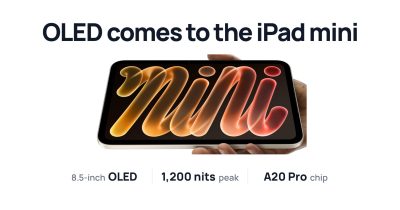
Stay informed as a product watcher.
Market insights that help you start and grow your business.