
When Your AI Assistant Asks for Your Bank Password, the Bank Says No
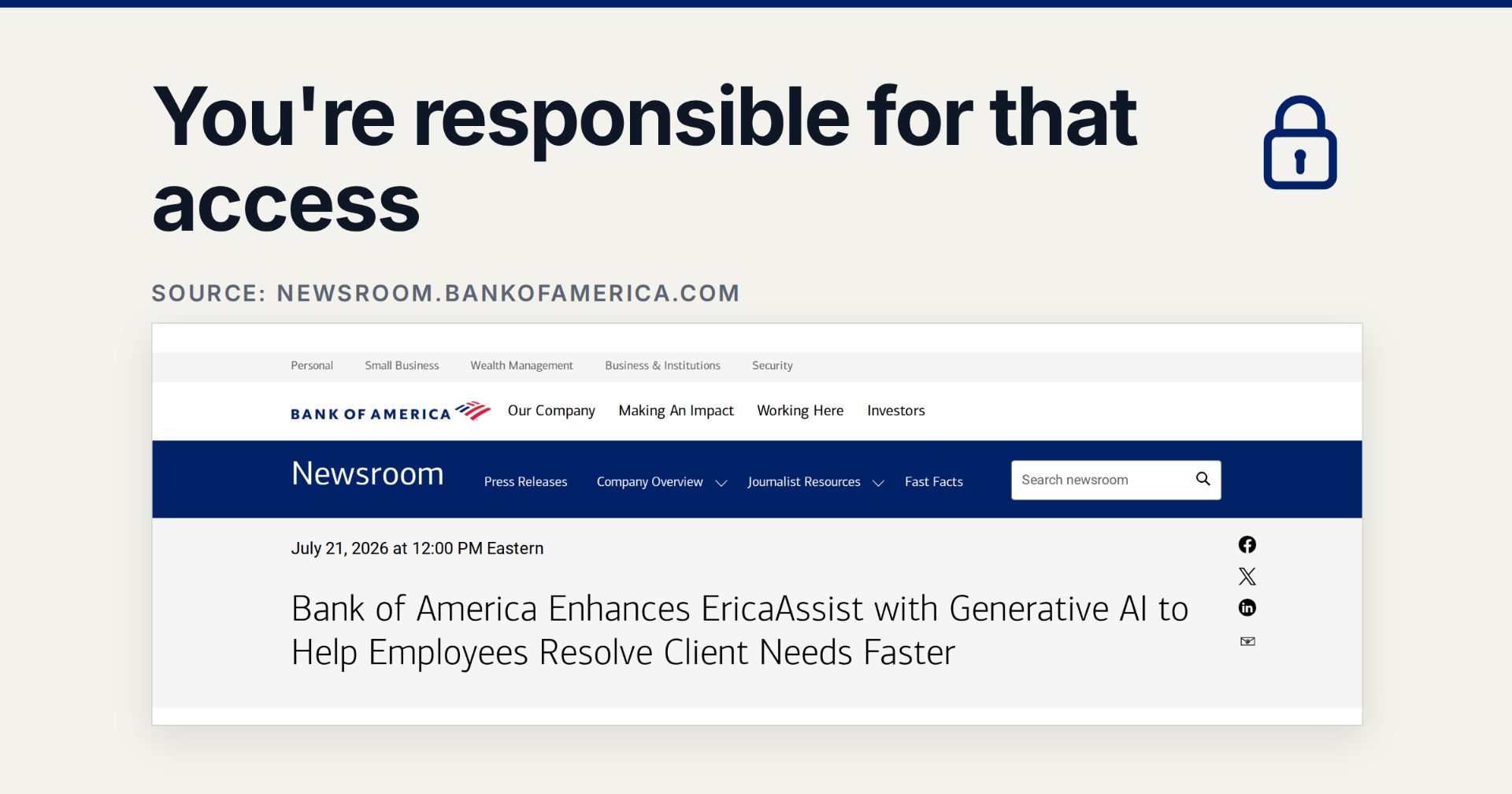
In late October 2026, Bank of America sent customers an email with a title that reads like it was written through gritted teeth: "Protecting your finances in the AI World." The message inside was blunt. Never share your username and password with another person or an outside service, the bank said, "including an AI-enabled tool or agent that offers to act on your behalf." A spokesperson later confirmed the email was genuine after a copy circulated on social media.
The warning is easy to skim past as generic security hygiene. It is not. It marks a real collision between two things happening at once: consumers are adopting personal AI agents fast enough that handing over logins feels like a convenience feature, and banks are pouring billions into their own AI programs while still trying to work out how third-party agents should ever be allowed near a customer's money. Bank of America's email sits precisely on that fault line, and its most uncomfortable sentence is the one about consequences: "If you do share your credentials, keep in mind that you're responsible for activity resulting from that access."
What the bank actually said, and why it said it
The email's core instruction is unremarkable on its face. Banks have spent two decades telling people not to reuse passwords, not to respond to phishing, and not to give anyone their login. What is new is the category of recipient. An AI agent is not a stranger on the phone and it is not a data aggregator quietly scraping a statement. It is a tool the customer deliberately installed, often paid for, and increasingly trusts with the kind of task that used to require opening an app and tapping through a few screens.
The risks the bank is pointing at fall into three buckets, and each one fails differently.
The first is unauthorized action. An agent holding valid credentials can move money, change contact details, open a product, or initiate a transfer without a human confirming each step. The customer granted access once and may not see the result until a statement arrives. An agent that misreads an instruction, acts on a stale goal, or is manipulated by a prompt injection in a web page or email it processes can produce an outcome nobody intended.
The second is defensive overreaction by the bank itself. Fraud systems are built to notice logins and transactions that do not look like the customer's normal behavior. An agent that checks balances at 3 a.m. from an unfamiliar network, or fires off several transactions in a pattern no human would produce, can trip those systems. The result is not a friendly notification. It can be a lockout, a frozen card, or a lengthy identity verification process at exactly the moment the customer needs access.
The third, and the one with the longest tail, is credential leakage. An AI assistant is a piece of software with its own supply chain: model providers, plugin integrations, browser extensions, logging pipelines, and support staff. A flaw anywhere in that chain can expose stored passwords. Unlike a stolen password that a customer might eventually notice and reset, a credential sitting quietly in an agent's storage may be copied and reused without any visible signal for months.
The awkward part: this bank is an AI pioneer
The warning lands with extra weight because Bank of America is not an AI skeptic. It is one of the more deliberate AI operators in financial services, and its public posture has been that AI belongs in the foundations of the company rather than in isolated experiments. Its consumer assistant, Erica, launched in 2018 and has since logged billions of client interactions. The bank has described an internal strategy of building once and reusing the underlying architecture across business lines, which is why the same natural language engine that supports retail customers also shows up in wealth management and corporate banking tools.
That reach extends to employees as well. The bank has reported that more than 90 percent of its roughly 213,000 employees use an internal virtual assistant, and in July 2026 it announced generative AI enhancements to EricaAssist, a human-assisted agent used by more than 18,000 customer service representatives. The company says the tool surfaces contextual guidance in under three seconds and trims nearly a minute from the average call. Its chief technology and information officer has described a pivot away from small proofs of concept toward end-to-end process transformation, backed by a technology budget in the tens of billions with a substantial share reserved for new initiatives.
So the bank is not telling customers that AI is dangerous. It is telling them that AI is fine when the bank runs it, inside governance the bank controls, and something else entirely when a stranger's agent holds the keys. That distinction is the heart of the story, and it is worth taking seriously rather than dismissing as institutional hypocrisy.
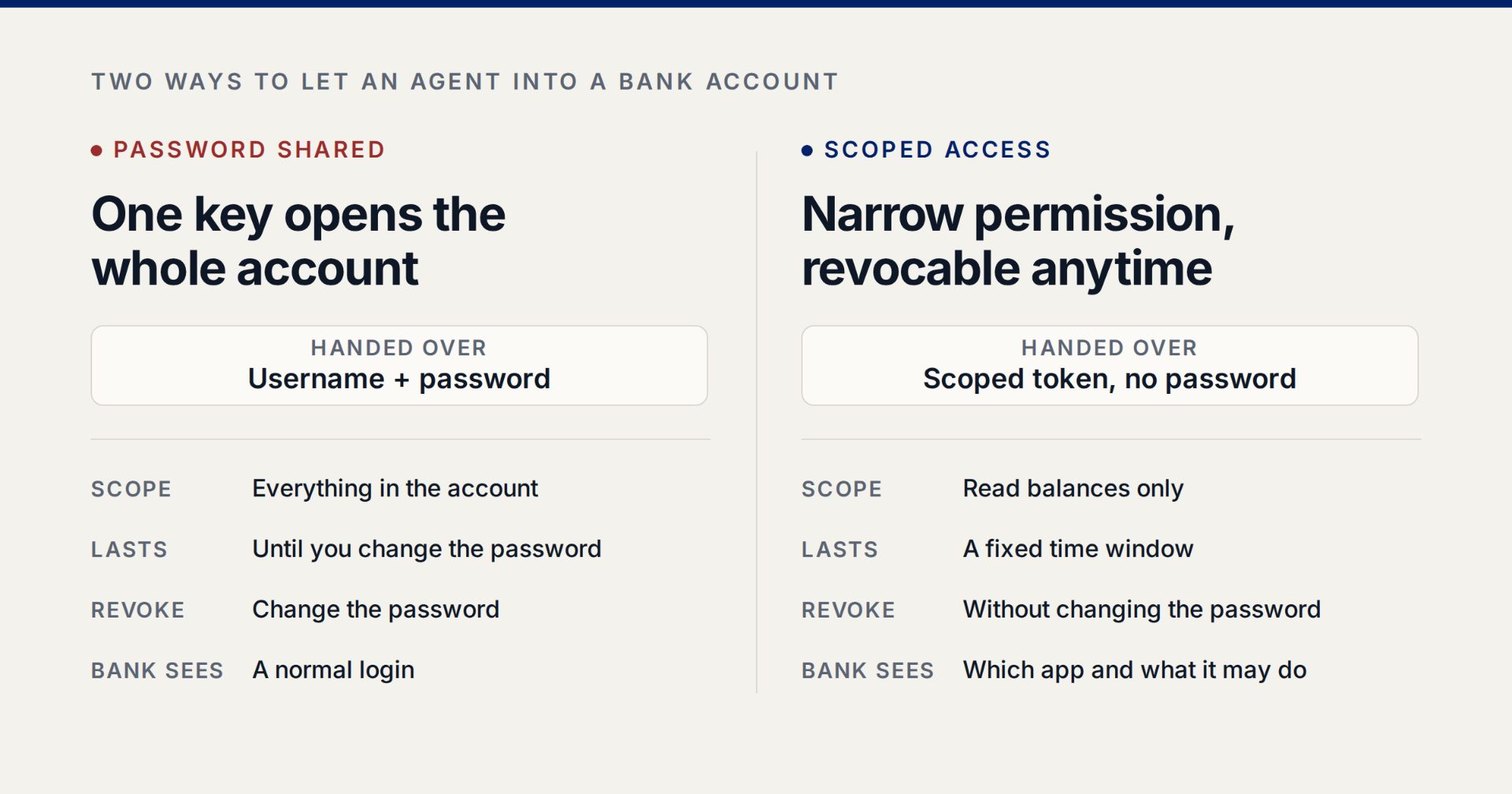
A bank-operated assistant like Erica works within a permissioned environment. It reads from systems the bank already governs, answers questions, and performs a limited set of actions under rules the bank defines and can audit. An external agent arrives with no such contract. It holds a password that unlocks everything, because that is what a password is: an all-or-nothing key that cannot be narrowed to "read my balance" or "pay this one bill."
Why banks cannot simply wave agents through
The industry's hesitation is not just cultural caution. It is a governance problem with a genuinely difficult shape. In an April 2026 interview, Bank of America's technology chief framed the tension plainly: governing this technology is hard, because overdoing it stalls innovation while underdoing it introduces a lot of risk. That is not a dodge. It is an accurate description of the trade-off every large institution is now managing.
The scale of the problem makes it sharper. The bank supports thousands of internal processes and is treating AI as something to be scaled across all of them. Enterprises broadly expect to increase generative AI spending substantially in 2026, which pushes the technology deeper into workflows and raises the stakes on guardrails. Meanwhile, the industry is still working out what an authorized agent even looks like at the account level.
Reports in October 2026 described major U.S. banks detecting what they believed were unauthorized actions by third-party AI agents operating inside customer accounts, with some agents apparently acting beyond what users had instructed. That is the scenario bank risk teams have been dreading: access that was granted, actions that were not. Distinguishing between the two after the fact is genuinely hard, because the login looks legitimate and the device may be the customer's own.
Who pays when the agent gets it wrong
The email's liability sentence is the part customers should read twice. Account agreements at most banks hold customers responsible for activity conducted by anyone they give their login to. An AI agent is, in the eyes of that agreement, someone you gave your login to. The bank has not authorized the agent, has no relationship with it, and cannot audit what it does. If it drains an account through a misread instruction, the starting position is that the customer authorized the access.
That asymmetry is what makes the credential-sharing question more than a security tip. It is a risk transfer. The convenience accrues to the customer in the short term, in the form of an assistant that can check balances or move money on request. The liability stays with the customer indefinitely, and the bank retains the right to treat the resulting activity as the customer's own.
This is also why the bank's warning is phrased as a request rather than a technical control. Banks cannot easily block a login that arrives with the correct password and a plausible device fingerprint. They can only detect anomalies afterward and act on them. That leaves prevention almost entirely in the customer's hands, which is an uncomfortable place for an industry that markets itself on protecting deposits.
What a safer delegation model looks like
The alternative to password sharing is not "no AI agents." It is delegated access: a permissioning layer where a customer grants a specific, limited, revocable authorization to a third party without ever disclosing the underlying credential. The pattern is well established in other corners of the internet. An authorization flow issues a token scoped to particular actions and a particular duration, the customer can revoke it without changing their password, and the bank can see exactly which application is acting and what it was permitted to do.
Open banking arrangements already provide a version of this for data sharing. In a statement to CBS News in October 2026, JPMorgan Chase said customers should not give their username and password to anyone and pointed to secure, customer-authorized data sharing through open banking providers as the way to meet customer needs while keeping accounts safe. That is the model the industry would prefer to extend to agents: the bank stays in the loop, the permission is narrow, and the audit trail is real.
The hard part is that agentic payments ask for more than read access. An agent that buys something at the best price or at the right moment needs the authority to initiate a transaction, which means the permission model has to carry spending limits, merchant categories, time windows, and a clear answer to what happens when the agent gets it wrong. Those are solvable design problems, but they are not solved yet, and they require banks, payment networks, processors, and agent developers to agree on interfaces that do not currently exist in any standardized form.
There is also a governance question inside the agent itself. Banks build their assistants with human oversight, transparency, and accountability baked into the design, and Bank of America says its responsible AI strategy requires human oversight for all outcomes. A consumer-grade agent bought off the shelf carries no such guarantee. Its operator may have no idea it is being used for banking at all, and its security posture was never designed for credentials that guard a person's savings.
A practical stance for customers right now
The realistic advice sits between two extremes. Handing a general-purpose AI assistant your banking password is a bad trade today, not because AI is uniquely dangerous but because the permission model is wrong. You are giving an all-or-nothing key to software you do not control, operated by a company with no contractual relationship to your bank, and you are absorbing the liability for whatever it does.
If an assistant genuinely needs to see account information, the safer path is the one the industry is already building: bank-sanctioned connections that issue scoped permissions rather than passwords. Where those do not exist yet, the next best option is to keep credentials out of the agent entirely and use the bank's own tools, which is exactly what the bank's email is asking for, however politely.
There are a few habits worth adopting regardless of how the market develops. Never paste a banking password into a chat window, even if the assistant claims it will not store it. Treat any agent that asks for a password as a warning sign rather than a feature. Turn on multi-factor authentication so that a leaked password alone is not enough. Review account activity on a regular cadence rather than waiting for a statement. And if you do decide to delegate access anyway, understand that you have taken on the risk, not the bank.
The road to agentic payments runs through governance
The awkward reality is that the convenience customers want is coming. Agentic payments, in which a person sets an agent to buy at the best price or the right time, are being actively explored by banks, payment providers, and processors. The demand is real and the technology works well enough to be tempting. What is missing is the connective tissue: standards for delegated authority, dispute rules for transactions an agent initiated, and clarity about which party absorbs the loss when an autonomous system does something nobody asked for.
Until that exists, warnings like Bank of America's will keep arriving in inboxes. They are not a rejection of AI. They are a statement about where the boundary currently sits: the bank will build agents it can govern, and it will not extend that governance to agents it cannot see. Customers who bridge that gap with a password are, in effect, doing the integration work themselves and keeping all the downside.
The email's tone may read as frustration, but the underlying position is coherent. A password is a master key, and master keys do not come with spending limits or an audit log. Until agents can be granted narrow, revocable permission to act, the safest answer to "can I have your banking password" remains the one the bank gave: no, and please do not ask again.