
Apple's New iPad Mini Finally Goes OLED, and the Price Goes Up With It
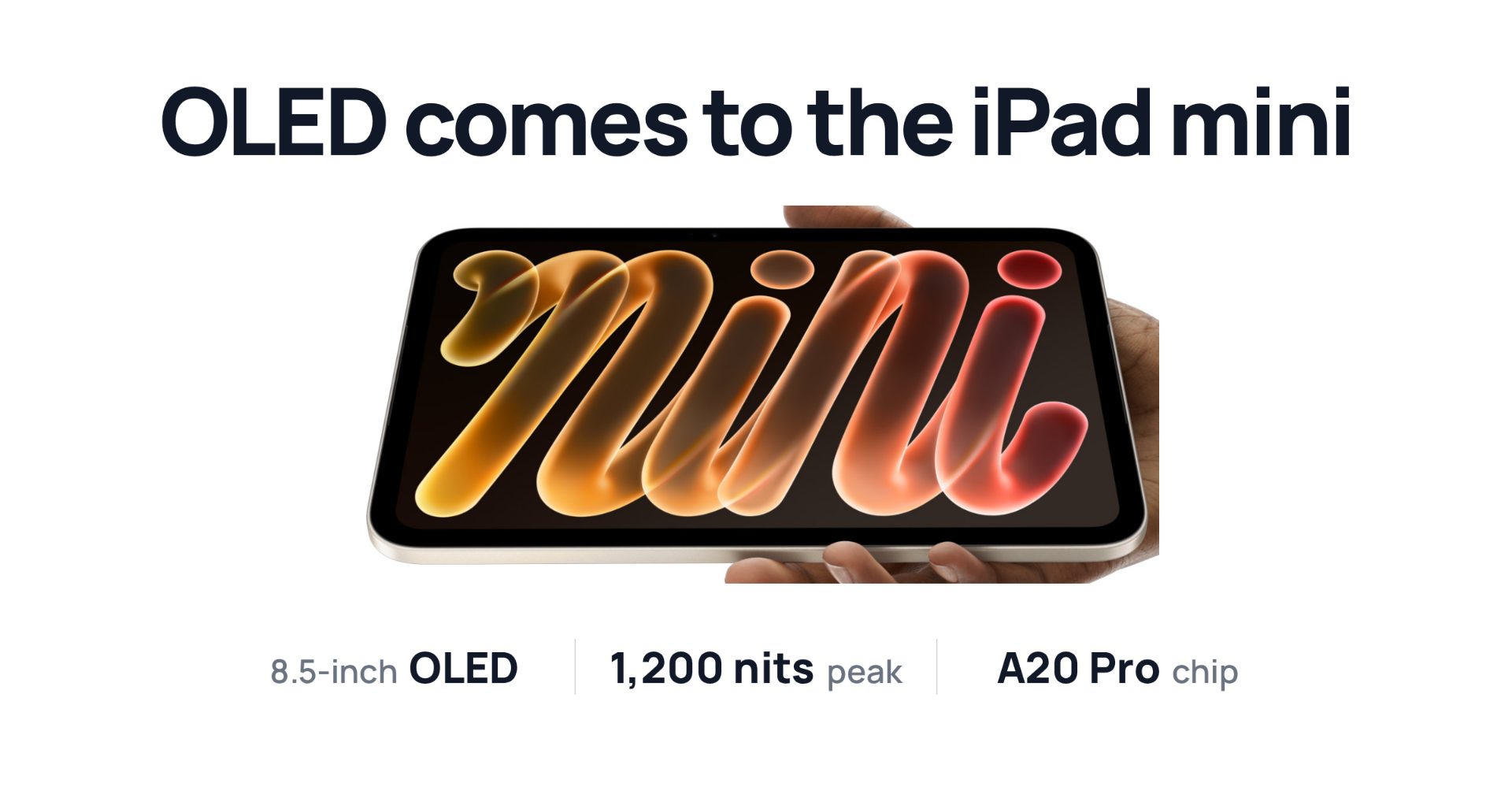
Apple announced a new iPad mini on Monday, and the headline change is the one small-tablet buyers have been asking for since the iPad Pro moved to OLED: the LCD panel is gone. The new model uses an 8.5-inch Super Retina XDR OLED display, runs on the A20 Pro chip that also powers this year's Pro iPhones, and starts at $699 for the Wi-Fi model and $849 for the cellular version.
The announcement arrived by press release, three days before Apple's "Pro and Tell" event in Los Angeles on October 28, where the company is expected to devote its stage time to Macs. That scheduling says something about how Apple views the mini. It is not a product that gets a keynote anymore, but it is one that Apple clearly still wants to sell at a premium.
The short version
The mini's jump is bigger than a typical refresh. Apple skipped two generations of its Pro-branded mobile silicon, moved from LCD to OLED, and shaved a full millimeter off the chassis. The table below compares what Apple is shipping now against the iPad mini (A17 Pro) that the new model replaced on the same day.
| Spec | iPad mini (A17 Pro), 2024 | New iPad mini (A20 Pro), 2026 |
|---|---|---|
| Display | 8.3-inch LCD, 2266x1488, 500 nits | 8.5-inch OLED (Super Retina XDR), 1,200 nits peak |
| Contrast | Not specified | 2,000,000:1 |
| Chip | A17 Pro, 6-core CPU, 5-core GPU | A20 Pro, 6-core CPU, 7-core GPU with Neural Accelerators |
| Thickness | 6.4 mm | 5.4 mm |
| Front camera | 12MP with Center Stage | 12MP with Center Stage |
| Starting price (Wi-Fi) | $599 | $699 |
| Starting price (cellular) | $749 | $849 |
Two numbers in that table deserve more attention than the rest, and neither of them is the chip. The first is the brightness figure. The second is the price.
The display: OLED finally reaches a second iPad line
Until now, OLED on an iPad meant buying an iPad Pro. The mini changes that. Apple calls the panel a Super Retina XDR display and describes it the way OLED is always described: pixel-level lighting control, which lets individual pixels switch off entirely rather than sitting behind a backlight. In practice that produces blacks that read as genuinely black, a contrast ratio Apple rates at 2,000,000:1, and support for the P3 wide color gamut.
The more consequential change for daily use is brightness. Apple rates the new panel at up to 1,200 nits peak, which it says is more than twice the previous generation, along with 600 nits of full-screen brightness for both SDR and HDR content. The outgoing mini topped out at 500 nits. Apple is pitching the combination of high peak brightness and true blacks as an advantage in dim rooms, where an OLED panel can hold detail in shadows without lifting the whole image the way an LCD backlight does.
Nano-texture comes down from the Pro
Apple is also offering a nano-texture display option on the mini, which cuts glare in bright environments. That coating has been an iPad Pro feature until now, and it matters more on a small tablet than a large one, because a mini is the device people actually hold up outdoors, on a train, or in a car. Whether the option carries a surcharge is not something Apple disclosed in the announcement.
The refresh rate question Apple did not answer
The A17 Pro mini ran at 60Hz, and that single spec was the most consistent complaint in every review of the device. A 60Hz panel makes scrolling and system animations feel less fluid than the 120Hz ProMotion displays on Apple's more expensive hardware, and on a tablet that costs as much as this one, reviewers treated it as a genuine shortfall rather than a nitpick.
Apple's announcement does not mention a refresh rate for the new model. That silence is worth flagging, because it is the one specification that decides whether the OLED panel feels like a flagship screen or a very good screen held back by its controller. Leaks ahead of launch suggested Apple had tested both 60Hz and 120Hz configurations. Buyers who care about smoothness should wait for the full specifications page rather than assume the upgrade includes ProMotion.
The Acoustic Display
Apple is also introducing what it calls an Acoustic Display, with specially designed woofers integrated into the display assembly. The company says this delivers deeper bass and higher volume when gaming, watching video, or editing content. Small tablets have always been limited by the physics of thin enclosures, so routing low-frequency drivers through the display layer is a plausible way to get more output from a body that measures 5.4 mm thick. Apple has not published a measured comparison against the previous model, and audio claims are the kind that need ears rather than spec sheets.
The A20 Pro and the AI pitch
The chip is the second half of Apple's story. The A20 Pro in the new mini has a 6-core CPU that Apple says delivers up to 60% faster multithreaded performance than the previous generation, which it frames around photo editing and running several apps at once.
The more interesting number is on the GPU side. The A20 Pro ships with a 7-core GPU that includes Neural Accelerators in each core, and Apple claims up to 4.5-times faster AI performance than the A17 Pro mini. That figure is large because of how the hardware changed, not just because the chip is newer. Putting matrix-multiply hardware directly into the GPU cores means on-device AI workloads can run on the graphics silicon instead of being funnelled entirely through a separate neural engine. Tasks that previously took seconds can start to feel immediate.
A few caveats are worth keeping in mind. The comparison baseline is a tablet that launched in October 2024, so a 60% multithreaded gain over two years is a normal cadence rather than a breakthrough. Apple also has not said how much memory the new mini carries. The previous model had 8GB, which was the threshold for the first wave of Apple Intelligence features. Memory will determine how much of the next-generation feature set the mini can actually run, and how well it handles large models locally.
There is one place where the shipping product beats the leaks. Reports before launch expected Apple to use a binned version of the A20 Pro with one fewer GPU core, mirroring how the A17 Pro mini shipped with five GPU cores instead of the iPhone's six. Apple's published specification lists all seven cores.
Design, camera, and connectivity
The new mini is 5.4 mm thick, down from 6.4 mm, and Apple says it is lighter as well, though the company has not published a weight. It comes in two colors. That is a reduction from the four finishes offered on the A17 Pro model, and it hints at a simplified production lineup rather than a broader one.
The front camera is a 12-megapixel unit with Center Stage, the feature that digitally pans and zooms to keep you in frame during video calls. Leaked schematics before launch suggested Apple had moved the camera to the landscape edge, which would make horizontal video calls look more natural. Apple's announcement lists the camera but does not describe its placement, so that change remains unconfirmed.
Connectivity gets faster on both the wireless and cellular side, though Apple has not specified which Wi-Fi or 5G standards the new model supports. The device also adds fast-charge support, again without a published wattage. Storage tiers beyond the base configuration were not detailed in the announcement.
Apple Intelligence and the new Siri
The mini launches alongside the next generation of Apple Intelligence and Siri, which Apple says can draw on a user's personal context to answer questions and understand what is on screen. The pitch is that the assistant can act on information across apps rather than only responding to a direct request.
The combination of a small screen and strong on-device AI is the most coherent argument for this product. A tablet you carry everywhere is exactly the device where a context-aware assistant is useful, and the Neural Accelerators in the A20 Pro's GPU exist to make that run locally rather than in a data center. Whether the features deliver depends on software that Apple has not fully detailed, but the hardware groundwork is clearly the point of the chip upgrade.
The price is the real story
The iPad mini launched at $499 in October 2024. Apple raised that to $599 in June 2026. With this model it moves to $699, with cellular at $849 instead of $749. In under two years, the entry point for Apple's smallest tablet has climbed by $200.
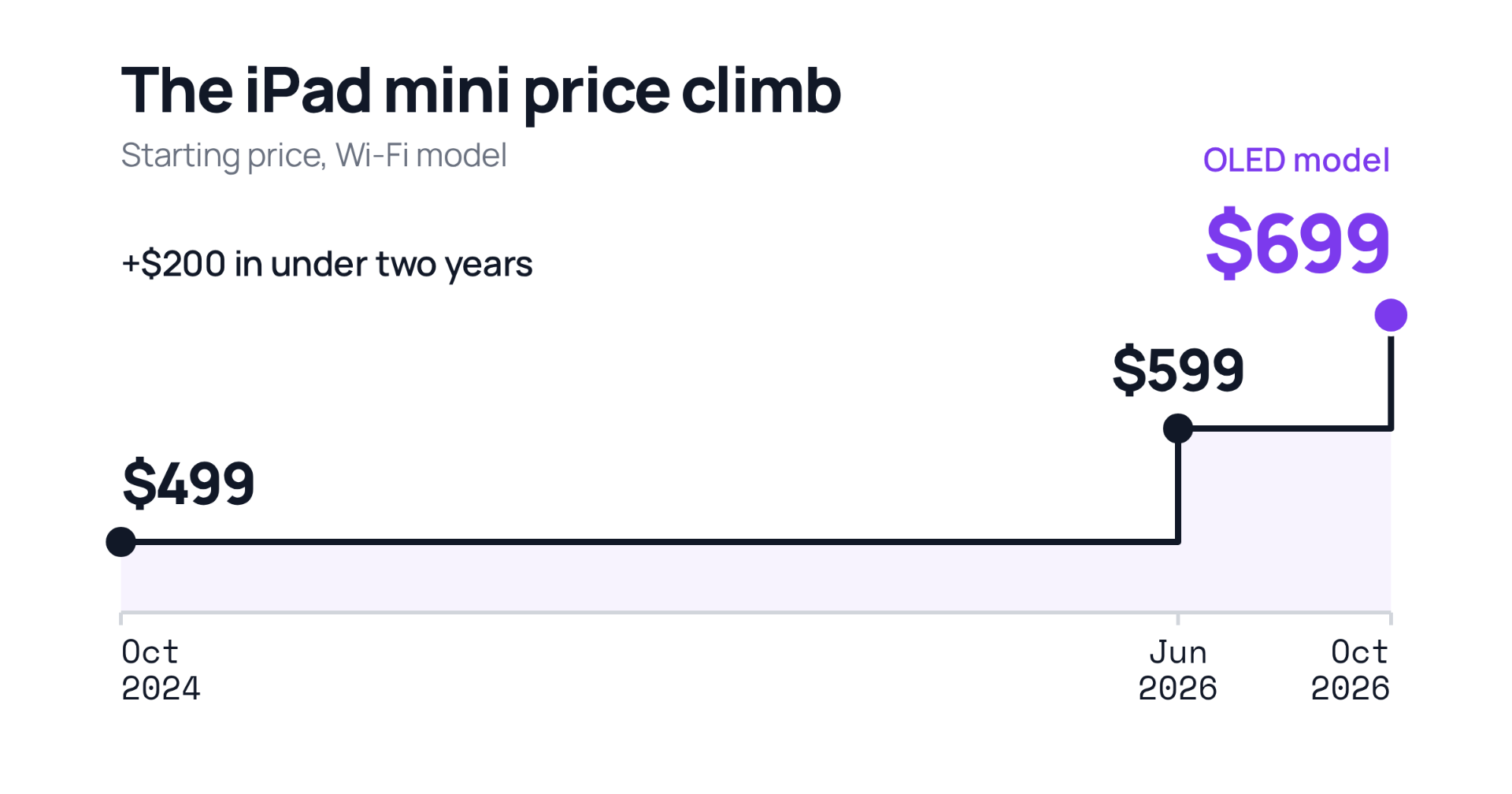
Some of that is defensible. OLED is more expensive to produce than LCD, the A20 Pro is a flagship-class part, and the new audio hardware is not free. But $699 puts the mini in uncomfortable territory. It is now priced within reach of larger iPads that offer more screen for multitasking and, in some cases, comparable silicon. The mini's entire identity is portability, and every price increase asks buyers to pay more for the one thing that makes it different.
There is also a subtler problem. If the refresh rate turns out to be 60Hz, Apple will be charging flagship money for a panel that is deliberately held below the company's own premium standard. That combination of a higher price and an unaddressed limitation is the hardest kind of upgrade to recommend.
Availability and where the mini fits in Apple's fall
The new iPad mini can be preordered on October 28, the same day as the Pro and Tell event, with availability beginning November 6.
The timing is crowded. Apple has already launched iPhone 18 Pro models and the iPhone Duo in September and held a separate "Welcome home" product launch on October 13. The October 28 event is expected to focus on Macs, with rumors pointing to touchscreen OLED MacBook Pro models, an M6 iMac, and an M6 version of the base MacBook Pro. Choosing to ship the mini by press release rather than on that stage tells you Apple expects it to sell on specification and word of mouth rather than spectacle.
Who should buy it
If you already own an iPad mini and your main frustration is the screen, this is the upgrade you have been waiting for. OLED with 1,200-nit peak brightness, a 2,000,000:1 contrast ratio, and an optional nano-texture coating addresses the two things the old panel did worst: blacks in dark rooms and legibility in bright ones. The A20 Pro's AI hardware is a meaningful step for anyone who wants the current Apple Intelligence feature set to run well on a device this small.
If you are buying a mini for the first time because you want a compact tablet for reading, notes, and travel, the math is harder. The A17 Pro model did those jobs comfortably, and it was cheaper. The new model's advantages are real but concentrated in display quality and AI headroom, and both are easier to justify at $599 than at $699.
If either of those describes you, wait for the full specifications. Refresh rate, memory, battery life, weight, and storage pricing are all still unknown, and each one changes the value calculation more than the chip's benchmark numbers will.
The bottom line
Apple has fixed the mini's biggest weakness and created a new one in the same announcement. The move to OLED, the A20 Pro with GPU-level neural acceleration, the thinner chassis, and the Acoustic Display add up to the most substantial update the small tablet has received in years. The price increase is the counterweight, and it lands on a product whose appeal was always about size rather than specification.
For Apple, the bet is that people who want a small tablet will pay flagship prices for one. For buyers, the decision comes down to a single unanswered question: whether the screen Apple is charging $699 for is allowed to run at the speed its hardware can support.
References
- Apple unveils new iPad mini with OLED display and faster A20 Pro chip - TechCrunch
- iPad Mini (A17 Pro) - Wikipedia
- iPad Mini 8 Leak: Apple's Smallest Tablet Could Get the iPhone 18 Pro's A20 Pro Chip - TechRepublic
- Apple "Pro and Tell" Event Set for 28 October 2026 - TidBITS Talk
cover_prompt
Poster with a single line of large text: "OLED comes to the iPad mini". Beneath the headline, place an official product image of the new iPad mini taken from Apple's product page at apple.com/ipad-mini. The reader sees the headline text first, then the tablet. Under the device, add a plain strip of three short figures: 8.5-inch OLED, 1,200 nits peak, A20 Pro chip. Keep the rest of the layout empty.