
Fox Closes Its $22 Billion Roku Deal: Strategy, Terms, and the Risks Ahead
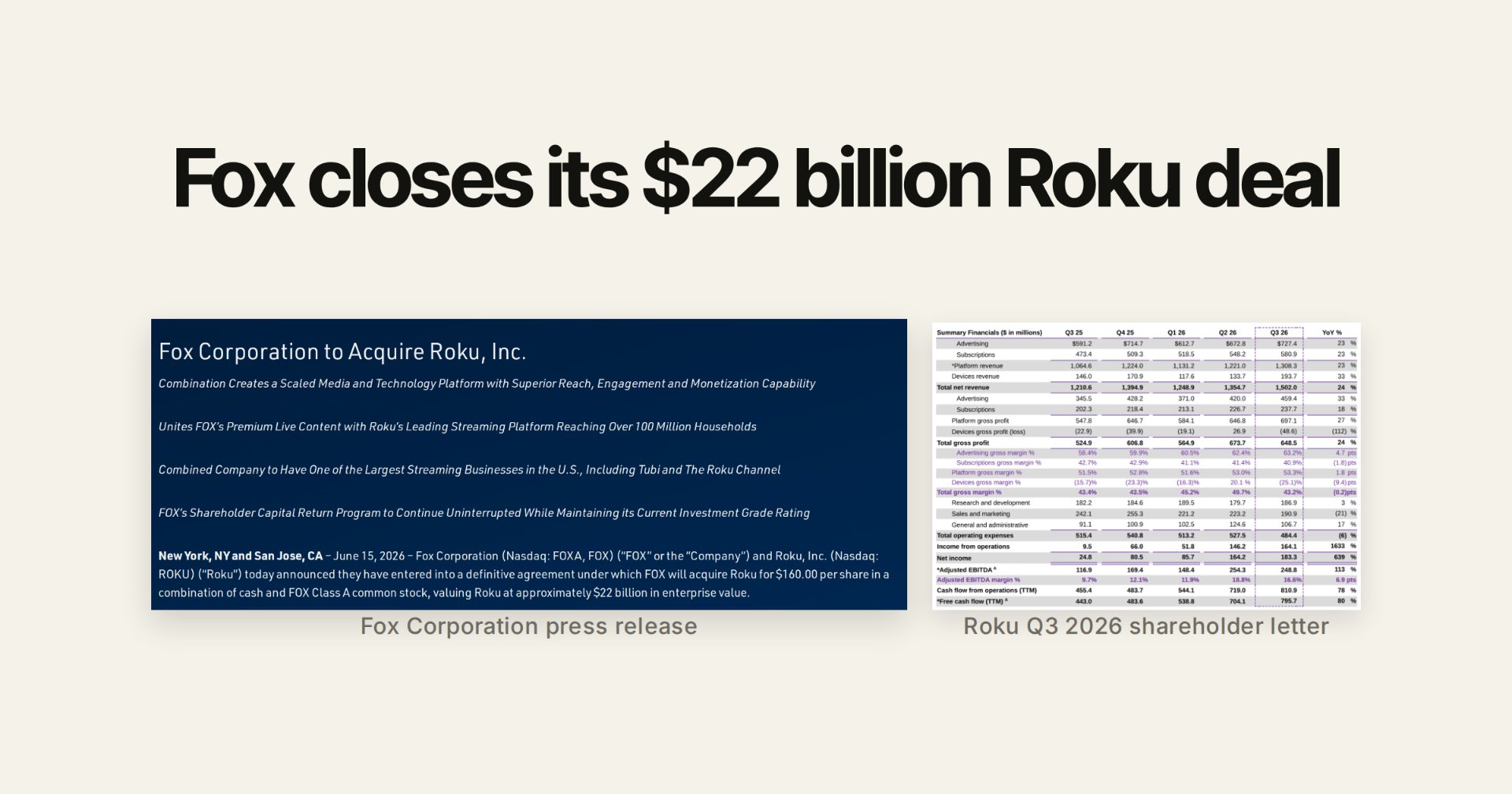
Fox Corporation completed its $22 billion acquisition of Roku on Friday, November 6, 2026, closing one of the largest media mergers in recent years less than five months after the agreement was signed and well ahead of the timetable the two companies had set in June. The deal gives Fox the leading connected TV operating system in the United States, an installed base of more than 100 million streaming households worldwide, and a direct advertising and subscription-billing relationship with a large share of the people who watch Netflix, YouTube, and Disney+ on a Roku player or a Roku-powered television.
For a company that has spent the better part of a decade arguing that live news and sports are the most valuable content in television, this is an unusual purchase. Fox is not buying more programming. It is buying the shelf where programming is found.
A deal that was not supposed to close until 2027
When the agreement was announced on June 15, 2026, Fox agreed to pay $160.00 per Roku share in a mix of cash and stock: $96.00 in cash and 0.9693 shares of Fox Class A common stock, with the stock portion valued at about $64.00 based on a $66.03 reference price, the ten-day volume-weighted average of Fox shares as of June 10, 2026. Existing Fox shareholders were expected to own about 73% of the combined company and former Roku holders about 27%. Fox lined up a $12 billion committed bridge facility from Morgan Stanley Senior Funding to fund the cash side, expected to carry roughly $8 billion of new debt, and projected net leverage of about 2.8 times earnings at closing, including half-credit for $400 million of targeted run-rate cost synergies.
| Item | Detail |
|---|---|
| Announced | June 15, 2026 |
| Enterprise value | About $22 billion |
| Price at signing | $160.00 per Roku share |
| Consideration at signing | $96.00 cash plus 0.9693 Fox Class A shares |
| Consideration at closing | $95.30 cash plus 0.9799 Fox Class A shares, per the New York Post |
| Ownership split | About 74% Fox, 26% former Roku holders |
| Financing | $12 billion committed bridge; about $8 billion of planned new debt |
| Pro forma net leverage | About 2.8x |
| Targeted synergies | About $400 million run-rate |
| Original close target | First half of 2027 |
| Actual close | November 6, 2026 |
The original schedule called for a close in the first half of calendar 2027. Instead the deal ran into a formal antitrust review, then out of it. The Department of Justice sent both companies a second request for information and documents on September 8, 2026, which extended the waiting period under the Hart-Scott-Rodino Act until 30 days after substantial compliance. Shareholders of both companies approved the transaction on October 14. By late October, reports suggested approval was close, and the department closed its investigation after concluding the combination was unlikely to harm competition, according to reporting summarized by Digg. Roku shares stopped trading on the Nasdaq on November 6.
The consideration that actually changed hands differed slightly from the June announcement. The New York Post reported closing terms of $95.30 in cash and 0.9799 Fox Class A shares for each Roku share, with Fox holders ending up with about 74% of the combined company and former Roku holders about 26%.
Why Fox wanted the front door
Fox's current shape is the product of a deliberate retreat. In 2019, after selling most of 21st Century Fox's entertainment assets to Disney, the remaining company reoriented itself around live news and sports, two categories that command premium advertising rates and still draw appointment viewing. In 2020 it bought Tubi for $440 million, well before free ad-supported streaming was an obviously good business. Under Fox, Tubi grew to roughly 110 million monthly active users, more than 13 billion hours of viewing a year, about 2.2% of all U.S. television viewing, and revenue approaching $1.5 billion in fiscal 2026. In August 2025, Fox launched Fox One, a subscription streaming service carrying the broadcast network and its cable channels.
What Fox did not own was the layer where viewers decide what to watch. Lachlan Murdoch framed the rationale around two forces: the persistence of live news and sports, and the continued shift of viewing to streaming. Nearly half of all U.S. television consumption now happens inside the streaming ecosystem, roughly double the 2020 level, by his account. The average consumer subscribes to about four services, which makes discovery harder and pushes viewers toward aggregators. Roku is the largest of those aggregators in the United States, and it is the platform through which a substantial share of American households reach every major streaming service, including Fox's competitors.
On a pro forma basis, Fox says the combined company becomes the third-largest television business in the U.S. by share of viewing, with a mix that spans broadcast, cable, local stations, and streaming. That claim is really a statement about reach: the same company now sells advertising against live sports and news, operates two of the larger free ad-supported services in Tubi and The Roku Channel, runs a subscription product in Fox One, and controls the interface that greets viewers when they turn on the television.
What Fox is actually buying
Roku was founded in 2002 on the premise that all television would eventually be streamed. It now claims the top spot in the U.S., Canada, and Mexico by hours streamed, with more than 100 million global streaming households, including more than half of all U.S. broadband households. Its platform carried 145.6 billion streaming hours in 2025, up 15% from the prior year.
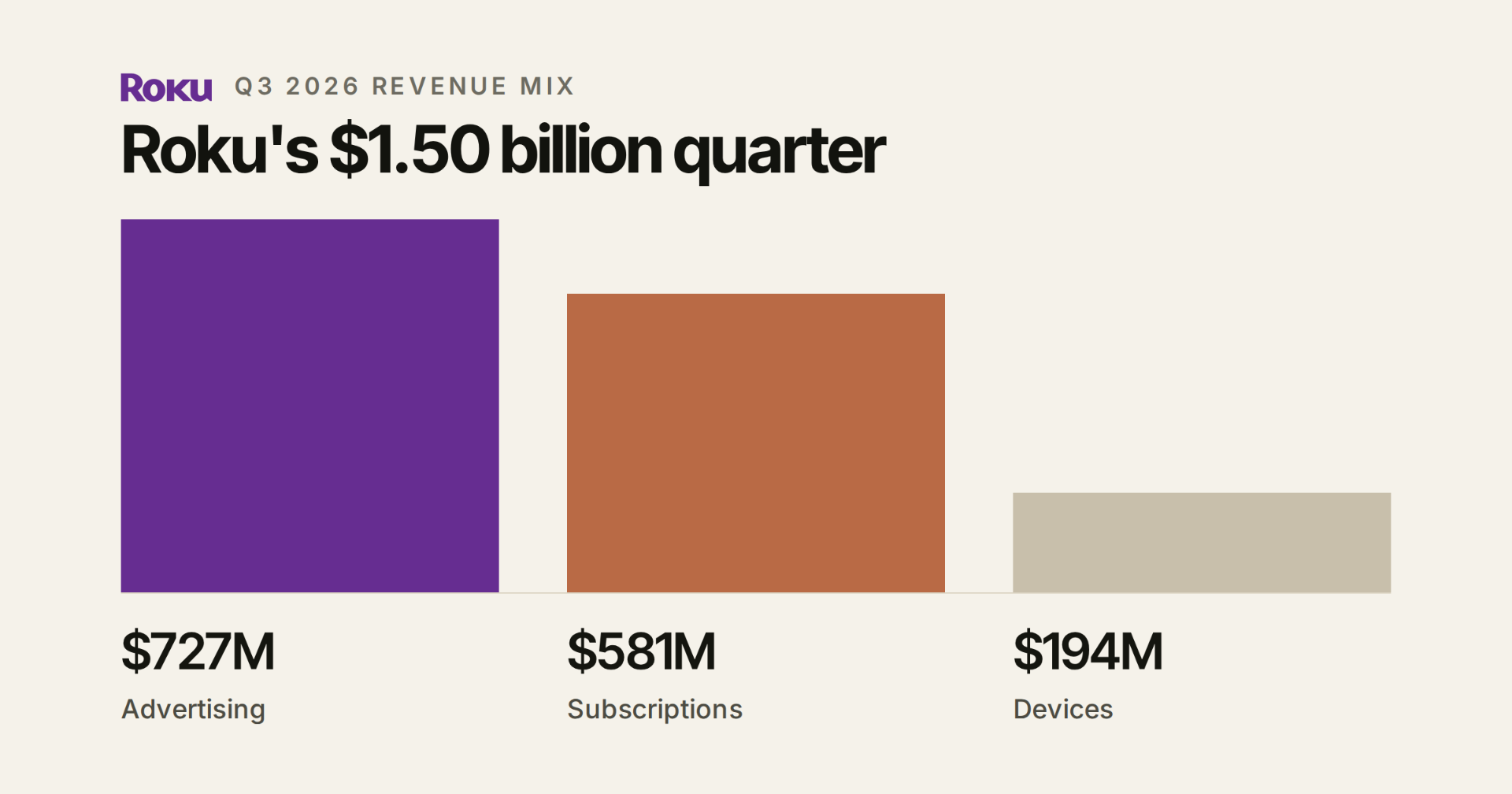
The most recent quarter shows both the growth and the shape of the business Fox is absorbing. Roku reported third-quarter 2026 revenue of $1.5 billion, up 24%, with platform revenue of $1.3 billion and a gross margin of 53.3%. Advertising revenue reached $727 million, the ninth consecutive quarter of double-digit growth, and subscriptions brought in $581 million.
| Metric | Q3 2026 | Change year over year |
|---|---|---|
| Total net revenue | $1.50 billion | +24% |
| Platform revenue | $1.31 billion | +23% |
| Advertising | $727 million | +23% |
| Subscriptions | $581 million | +23% |
| Devices revenue | $194 million | +33% |
| Gross profit | $649 million | +24% |
| Net income | $183 million | +639% |
| Streaming hours | 39.9 billion | +9% |
Roku is also less dependent on hardware than its origins suggest. Advertising and subscriptions generated almost all of the gross profit, while the devices segment, which exists mostly to seed the installed base, posted a gross loss of $48.6 million in the third quarter. Independent measurement puts Roku at about 37% of the connected TV device market globally and in the U.S. in the second quarter of 2025, far ahead of Amazon at 17%, according to Pixalate data reported by TV Tech. The Roku Channel was the second most-engaged app on the platform in the U.S. and globally in the third quarter, behind only whatever the viewer opened first.
The regulator's price of admission
The second request put the deal on the defensive for most of September and October. Competitors raised questions about how a Fox-controlled Roku would treat rival services: whether Fox apps would get more prominent placement, whether Roku's viewing data would be used to sharpen Fox's advertising, and whether rival streamers would drift down the home screen. Murdoch had said earlier that he expected the two businesses to operate separately while selling advertising across them, and Fox and Roku committed publicly to keeping the platform open to every content partner.
Those promises became more concrete as the review closed. According to Washington Post reporting summarized by Digg, Fox told the government it would keep carrying competitors' content on Roku for at least three years and would not discriminate against rival media companies using the platform. The review was also watched as a test of how the Justice Department handles politically sensitive media mergers; Senator Elizabeth Warren wrote to the department in July 2026 urging an impartial review free of political interference, and several states, including New York, were examining the deal as federal approval neared.
The three-year commitment is the part that will matter most over time. It covers the period in which Fox faces the strongest temptation to use the home screen, recommendation surfaces, and first-party data to favor its own services. Once it lapses, the constraint becomes commercial and reputational rather than legal, which is why the openness language in the executives' statements reads less like a courtesy and more like a promise the combined company will be held to.
How the combined company is wired
Roku sits inside a new division called Fox Digital Platforms, alongside Tubi, Fox One, and Red Seat Ventures, the podcast company Fox acquired in 2025. Anthony Wood, Roku's founder, joins the Fox board and serves as co-chair of the division with Paul Cheesbrough, who is co-chair and chief executive of Fox Digital Platforms. Mustafa Ozgen, previously Roku's president of devices, products, and technology, becomes Roku's chief executive, according to a staff memo reported by Business Insider and summarized by Digg. Tubi and Frndly TV move into Pete Distad's direct-to-consumer portfolio alongside Fox One, with Mike Bidgoli named Tubi president. Anjali Sud, Tubi's chief executive, is leaving the company, as are Roku Media president Charlie Collier, Roku general counsel Chris Handman, and AdRise executive Robyn Peterson.
The executives have been explicit that the operating model is unfinished. Cheesbrough and Wood told staff they would not have every answer on day one, and set up three core teams to run the first 100 days while the long-term structure is settled. Fox expects annual cost savings to reach roughly $400 million within two years of closing, and a target that size implies overlap in ad operations, marketing, general and administrative functions, and possibly in the two free streaming services.
The advertising argument
The financial case rests on advertising rather than subscriptions. Roku's ad business grew 23% to $727 million in the third quarter with a gross margin of 63.2%, up about 470 basis points year over year as the mix shifted toward higher-margin formats. More than 80% of in-stream video ad impressions were delivered programmatically, and Roku maintains integrations with every major demand-side and supply-side platform, including a planned expansion with Google's DV360. Fox brings its own ad sales operation, a portfolio of live sports and news inventory, and a direct-to-consumer service that needs to acquire subscribers efficiently.
Owning both the content and the operating system creates options neither company had alone. A single buy could pair live football inventory with home screen placements. Measurement could lean on platform-level data rather than third-party panels only. Subscription bundling becomes easier because Roku already signs up and bills customers for premium services through Roku accounts, which means it earns revenue when partners grow and retain subscribers.
The open question is whether that combination produces durable pricing power or simply more inventory in a market that keeps adding supply. Connected TV advertising has grown quickly, but much of the growth has come from viewers migrating rather than from budgets expanding, and the largest platforms, including Amazon and Google, are competing for the same dollars with their own data and their own measurement claims.
What could still go wrong
The most obvious risk is structural. Fox now owns the storefront and sells goods on it, and its most important tenants are its competitors. The three-year non-discrimination commitment addresses the near term, but every product decision after that, from autoplay behavior to search ranking to the price of a home screen takeover, will be read by rivals as evidence of preference. A single high-profile dispute with a streaming partner would turn a commercial negotiation into a regulatory story.
Integration is the second risk. The leadership changes landed on day one, and the long-term structure has not been set. Cost synergies of $400 million require eliminating duplicated roles, which is harder when the acquired company's engineering culture is the asset being bought. Wood's willingness to stay, and his board seat, help; they do not resolve the question of who owns product decisions in year two.
The balance sheet is the third. Pro forma net leverage of about 2.8 times is manageable for a company with Fox's cash generation, but it leaves less room to absorb an advertising downturn than Fox had before. The company has said its investment grade rating and its capital return program continue uninterrupted, and that free cash flow per share accretion arrives by the second full year after closing. Both claims depend on Roku's growth holding up while the two businesses are being merged.
Then there is competition at the device layer. Roku leads, but Amazon, Google, Samsung, and LG all ship their own platforms, and every one of them wants the same advertising and data economics. Roku's advantage has been openness, meaning that it carries every major service and does not privilege its own content. That advantage is exactly what the new ownership makes harder to preserve.
What changes for viewers, advertisers, and rivals
For viewers, the short answer is very little on day one. The platform stays open, the app lineup does not change, and Roku's own services remain a small part of what people actually watch. The plausible changes arrive later: more aggressive bundling of subscriptions through Roku accounts, more Fox content surfaced in recommendation features, and more promotional placements that look like content.
For advertisers, the deal creates a simpler pitch. One company can now sell linear sports and news, Tubi, The Roku Channel, and platform-level placements, with targeting that draws on first-party viewing data. That is attractive to media buyers who have spent years stitching together buys across separate platforms, but it also gives one seller considerably more leverage in negotiations.
For rivals, the dependency is uncomfortable. Netflix, Disney+, and YouTube do not need Roku to survive, but a meaningful share of their U.S. viewing starts on a Roku device. The three-year commitment buys them time. It does not change the fact that their most important distribution partner is now also a content company with its own streaming ambitions.
The strategic bet
Fox has spent a decade arguing that focus beats scale for its own sake. It sold its studios, kept its news and sports, bought a free streaming service before the market believed in one, and launched a subscription product of its own. Buying Roku is the first time in that run that Fox has bought distribution rather than content, and it is a much larger and riskier bet than Tubi was.
The logic is coherent. If streaming keeps taking share of viewing, if live sports and news remain the programming that advertisers cannot substitute, and if the home screen is where the next round of advertising and subscription economics is decided, then owning the largest independent operating system in the country is worth $22 billion. Roku's third-quarter numbers, with 23% growth in both advertising and subscriptions, support the timing argument.
The bet fails if Fox cannot resist using the platform to advantage its own services, if integration distracts the teams that built Roku's technology, or if regulators and rivals conclude the openness promise was a three-year formality. The deal is closed. The harder work, making a content company and a platform company behave like one company without acting like a gatekeeper, has just started.