
Serve Robotics Wants to Be the AWS of Physical AI
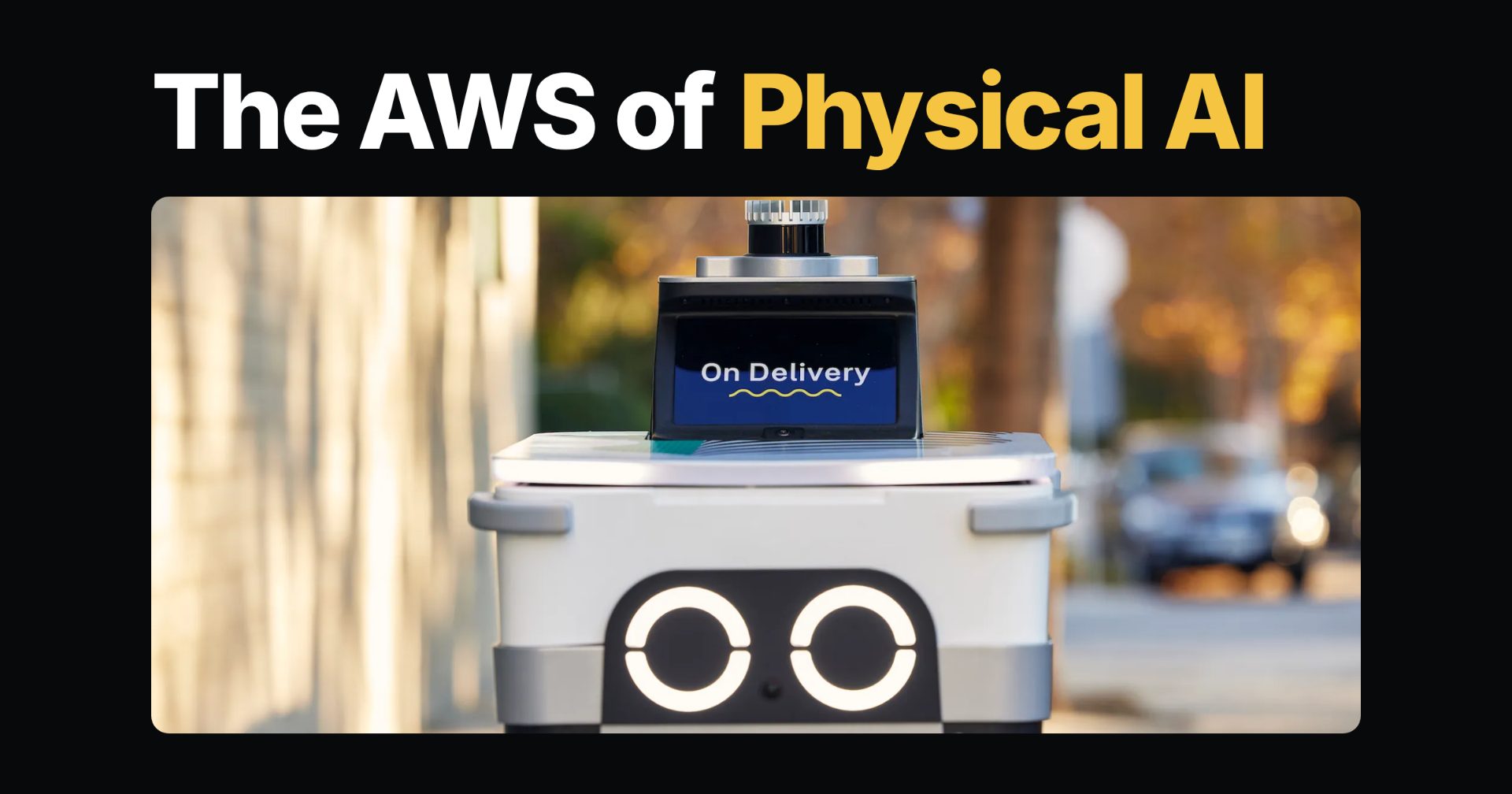
On November 5, 2026, Serve Robotics used its third-quarter earnings announcement to make a strategic point that went beyond delivery robots. The company introduced Physical AI Services, a business line that sells the connectivity, data curation, and training data infrastructure behind its own fleet. The pitch is straightforward: other robotics companies should not have to rebuild the operational layer that makes a robot fleet reliable. Serve wants to supply it.
That idea is easy to summarize and hard to execute. Serve is best known for googly-eyed sidewalk delivery robots, and it has deployed more than 2,000 machines across more than 40 cities and 27 hospitals. It spun out of Uber's Postmates acquisition in 2021, went public in 2024, and acquired Diligent Robotics in 2026 to add hospital robots. Now it wants to be infrastructure for physical AI, a term for AI systems that perceive and act in the physical world. CEO Ali Kashani calls the move an AWS moment: take technology built for internal use, then open it to others.
Why robot fleets need an operating layer
A robot that works in a lab is a demo. A robot that works on a sidewalk, in a hospital corridor, or on a construction site is an operations problem. The machine has to perceive its surroundings, but the company behind it also has to keep the machine connected, monitor it, route data, handle exceptions, update models, and prove that the whole system is safe. Those jobs do not disappear when a robot becomes autonomous. They become more demanding.
The hardest parts are usually invisible in a product demo. Wireless networks are unreliable. A robot may move between Wi-Fi, LTE, 5G, and satellite links. A camera feed may be useless for a few seconds. A model running onboard may lack the compute to handle an unusual situation. A fleet may generate more data in a day than a team can review in a month. Each of these problems sits between the robot and the intelligence that makes it useful.
Serve's new business is built around that gap. Physical AI Services is not a robot. It is a set of tools for connecting robots to off-board intelligence, finding valuable training examples, and supplying real-world data for foundation models. In practical terms, Serve is productizing the middleware and data operations it needed to run its own fleet. That is a different business from designing and operating delivery robots, even if the two share a technical foundation.
The AWS analogy, and its limits
The Amazon comparison is useful because it explains the strategic logic. Amazon built computing, storage, and database systems for its own retail operations. Over time, it turned those internal systems into Amazon Web Services and sold them to other companies. The internal workload proved the technology, created operational discipline, and supplied a reference customer. Serve is making a similar argument. Its fleet is the reference customer. Other robot builders are the market.
Kashani's version of the playbook is that a company should build the end-to-end application while a technology is young, because that is how it learns what the real problems are. As the technology matures, more companies will want to build similar systems. At that point, the original builder can open its technology so others build with it and on it. That is the theory behind Physical AI Services. Serve is not abandoning delivery robots. It is trying to turn the systems around them into a second revenue stream.
The analogy has limits. AWS sells compute that is broadly standardized. Robots are not. A sidewalk delivery robot, a construction machine, a mining vehicle, and an autonomous truck have different sensors, safety cases, duty cycles, and network conditions. A connectivity layer can be generalized, but only if it is designed for that variety. Serve's tools were shaped by its own fleet, which is both an advantage and a constraint. The advantage is real-world proof. The constraint is that a system tuned for one fleet may need significant work to serve another.
There is also a business-model tension. Serve operates delivery robots and now wants to sell infrastructure to other robotics companies. Some of those companies may compete with Serve in last-mile delivery. Others, such as Bedrock Robotics in construction, do not. The more Serve looks like a neutral supplier, the more customers it can attract. The more it looks like a competitor, the more some buyers will hesitate. That is a trust problem as much as a technology problem.
Three products, one data flywheel
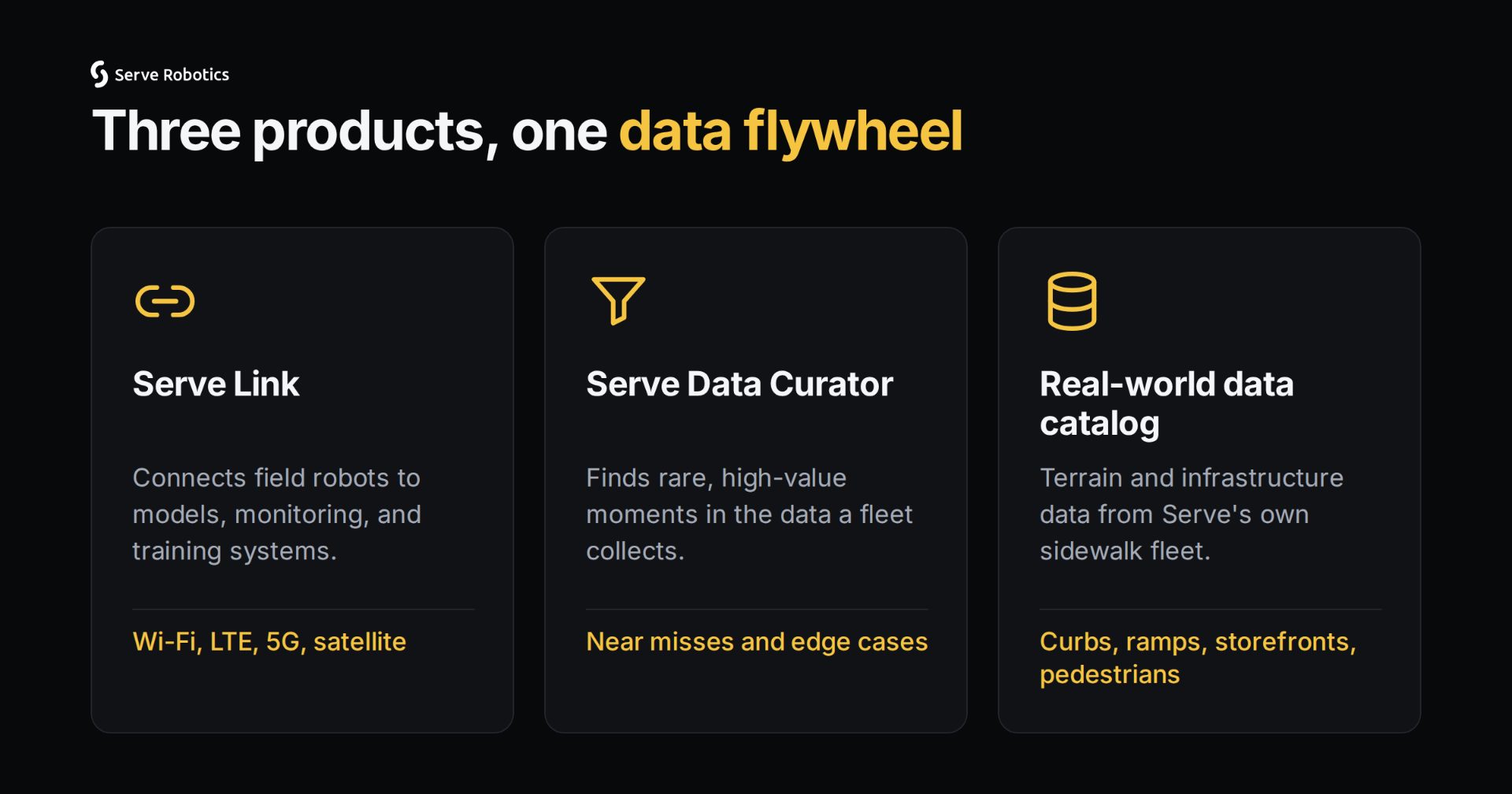
Physical AI Services launched with three products. They are not independent features. Together they describe a loop: connect the robot, collect the data, find the important examples, improve the model, and deploy the update.
| Product | What it does | Why it matters |
|---|---|---|
| Serve Link | Connects field robots to models, monitoring, and training systems over Wi-Fi, LTE, 5G, and satellite | Lets robots use off-board compute and keep working across unreliable networks |
| Serve Data Curator | Finds rare, high-value moments in the data a fleet collects | Shortens the loop from field data to model improvement |
| Real-world data catalog | Provides terrain and infrastructure data from Serve's sidewalk fleet | Gives models a foundation for complex human environments |
Serve Link is the most infrastructure-like of the three. The company describes it as a high-performance, reliable link between machines in the field and the models, monitoring systems, and training systems that make them smarter. The phrase high-performance matters. Opening a network connection is not the hard part. The hard part is maintaining a usable session across handoffs, dead zones, changing latency, and limited bandwidth while preserving safety and observability. A robot that loses its link at the wrong moment is not just offline. It may become a hazard.
Link also reflects a shift in where robot intelligence lives. Some computation has to stay onboard because latency, safety, or bandwidth makes off-board processing impractical. But other work can move to data centers, where models can be larger and easier to update. Serve's argument is that robots will increasingly need both. The robot needs enough onboard intelligence to act safely, and a reliable link to off-board systems for data collection, exception handling, and model improvement. Bedrock Robotics uses Serve Link to connect its construction machines over Wi-Fi, LTE, 5G, and satellite networks. That mix of networks is a reminder that physical AI often runs where infrastructure is incomplete.
Serve Data Curator addresses a different bottleneck. Robot fleets produce a flood of real-world data, but most of it is boring. The valuable examples are rare: a near miss, an unusual obstacle, a construction detour, a crowd behaving in an unexpected way, or a piece of infrastructure that does not match the map. A team cannot review every minute of video. A curation tool surfaces the moments that are worth labeling and training on. That is not a small convenience. In machine learning, the quality and coverage of training examples often matter more than the raw volume of data.
The third product is a real-world foundation-model data catalog drawn from Serve's own sidewalk deployments. It includes terrain and infrastructure data that can teach models how to understand complex human environments such as city sidewalks. A catalog is not a model. It is a feedstock. Its value depends on coverage, labeling, rights, and how well it transfers to a customer's environment. A construction site is not a sidewalk, but both are uncontrolled spaces with people, obstacles, and changing conditions. A dataset that helps a model understand curbs, ramps, storefronts, pedestrians, and street furniture can still be useful as a starting point.
Who buys this, and why Bedrock is a useful first customer
Bedrock Robotics is a sensible launch customer because its machines operate in conditions that stress every part of the stack. Autonomous construction equipment works in remote locations, around heavy machinery, and often on networks that are less predictable than a city sidewalk. The company builds self-driving systems for heavy construction equipment, and it uses Serve Link to connect its machines across multiple network types. That is a more demanding environment than a food delivery route in some ways, and a less demanding one in others. It is exactly the kind of customer a platform business needs: technically serious, operationally complex, and not a direct competitor in Serve's core delivery market.
Serve says Physical AI Services already powers thousands of vehicles across about a dozen industries, including construction, mining, and autonomous trucking, as well as its own sidewalk delivery fleet. Those industries share a need for reliable connectivity and data operations, but they do not share the same safety rules, sensors, or business models. That breadth is the opportunity and the challenge. A platform can amortize development across many customers. It can also become a pile of custom integrations if the product is not abstracted well.
Serve is also working with T-Mobile to bring AI computing power closer to robots. That detail is easy to overlook, but it points to an important architectural question. If every robot sends all its data to a distant data center, latency and bandwidth become expensive. If more compute sits closer to the robot, some decisions can happen faster and some data can be filtered before it travels. The right split between onboard, edge, and cloud compute will vary by application. Serve Link is the plumbing that lets customers choose.
What Serve brings to the table
The strongest part of Serve's case is that it did not invent a platform in a vacuum. It built one while operating a fleet. The company has deployed more than 2,000 robots across more than 40 cities and 27 hospitals, reaching a population of about 3 million people and supporting delivery for more than 4,000 restaurants. It has dealt with real sidewalks, real weather, real pedestrians, and real network failures. That experience is difficult to copy from a lab.
The Diligent acquisition adds a second environment. Moxi, Diligent's hospital robot, has completed more than 1.25 million deliveries across more than 25 hospital facilities. Hospitals are dense, human-centric, multi-level spaces with constant edge cases. They are also regulated environments where reliability and safety are not optional. Serve has said that the combined company will share an autonomy and AI stack, with every robot contributing data to the same physical AI platform. That is the flywheel argument: more robots in more environments produce more data, which improves models, which makes deployment easier, which attracts more robots.
That flywheel is plausible, but it is not automatic. Data from a hospital does not automatically improve a sidewalk robot, and data from a construction site does not automatically improve a delivery robot. Transfer depends on representation, labeling, and model architecture. Serve's platform thesis is that a common operational layer can make the transfer easier. The company still has to prove that the layer is general enough to be useful and specific enough to be reliable.
The business case and the risks
Serve's core business is growing. In its third-quarter 2026 results, the company reported revenue growth of more than 300 percent year over year and raised full-year revenue guidance for 2026 to $12 million. It also tripled daily average deliveries with new delivery partners. The delivery business is also shifting. TechCrunch reported that Serve is moving away from Uber and toward other partners, including DoorDash and Wonder. That diversification matters because platform businesses need a stable base while they build a new revenue line.
Physical AI Services could improve the economics of the company if it becomes a recurring, software-like business. Hardware businesses in robotics often face thin margins and constant research and development pressure. A platform business can add revenue without a proportional increase in manufacturing cost. That is the appeal of the AWS comparison. It is also why investors may tolerate the cost of building a second business if the second business eventually scales.
The risks are just as clear. Serve has not disclosed pricing for Physical AI Services, and it has not said how many customers are paying beyond the launch references. A platform business needs repeatable sales, documentation, support, service-level agreements, and a developer experience that is good enough for other engineering teams to build on. Those are different skills from running a robot fleet. Serve will have to sell to customers who may be skeptical of depending on a company that also operates robots. It will also face competition from larger infrastructure providers and from robotics companies that prefer to build their own stack.
The AWS comparison sets a high bar. AWS became AWS after years of internal scale, a broad set of services, and a developer ecosystem. Serve is at the beginning of that journey. The more accurate description today is that Serve is opening an internal platform to selected customers and testing whether the market wants it. That is a credible first step. It is not yet proof of a platform business.
What to watch
The next signals will matter more than the launch announcement. Watch whether Serve discloses pricing and customer counts for Physical AI Services. Watch whether Data Curator and the data catalog become packaged products with clear metrics, or remain custom services. Watch whether Serve Link publishes reliability figures, because connectivity is a promise that can be measured. Watch the T-Mobile collaboration, since edge compute could change the cost and latency profile of the whole stack. And watch how Serve handles data governance. A real-world data catalog is valuable only if customers trust how the data was collected, labeled, and licensed.
The broader significance is that robotics is maturing into a layered industry. Not every company will build its own connectivity layer, data pipeline, and training infrastructure. Some will buy those capabilities from a specialist. If Serve can be that specialist, it can grow beyond delivery robots without abandoning them. If it cannot, Physical AI Services will remain a useful side business attached to a fleet operator.
Conclusion
Serve Robotics is making a bet that the most durable value in physical AI may sit between the robot and the model. The robot is the visible product. The connectivity, curation, and data layer is the operating system that makes the product reliable at scale. Serve built that layer for its own fleet, and now it wants other companies to build on it. The AWS analogy is a useful way to describe the ambition, but it is not a guarantee. The company has real operational experience, a growing fleet, a hospital business, and a launch customer in construction. It also has to prove that its tools generalize, that its sales motion works, and that customers trust a supplier who is also an operator. The next phase of the story is not about whether Serve can build a robot. It is about whether other robot builders will build on Serve.